

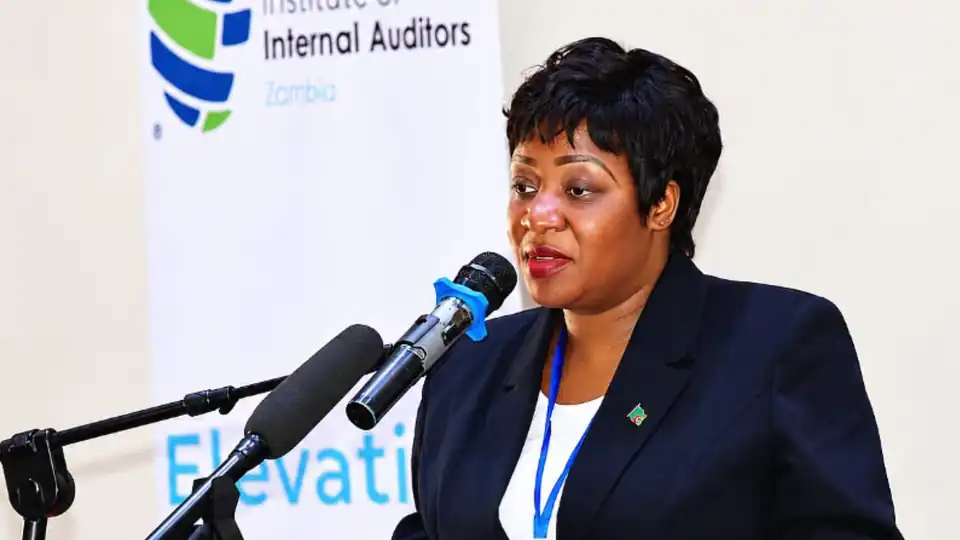
About 350 internal auditors across Zambia’s ministries, provinces and agencies will go through standardised training and certification at NIPA, as Government tries to make sure budget money turns into services that actually reach citizens.
Key takeaways
- Controller of Internal Audit Jamie Mukuwa opened a five-day Internal Audit Training Programme at the National Institute of Public Administration (NIPA) Main Campus in Lusaka.
- About 350 public service internal auditors will be trained and certified through NIPA under Public Service Management Division Circular No. B4 of 2026. The first cohort has about 50 officers.
- Controlling Officers and Heads of Internal Audit Units are expected to provide for the training in their institutional plans and budgets.
- The programme puts into practice the Public Service Competence Development and Certification Strategy launched on 30 June 2026.
- Institute of Internal Auditors Zambia President Lubinda Namiluko called for compliance with the Global Internal Audit Standards and more attention to cybersecurity risk.
Government is moving to a single standard for the people who check how public money is managed inside ministries. Internal auditors across the Public Service will undergo standardised training and certification through NIPA, so that auditors in every ministry, province and agency apply comparable professional standards, quality requirements and assurance practices.
Opening the first round of training in Lusaka, Controller of Internal Audit Ms Jamie Mukuwa said weak internal controls end up hurting ordinary people through undelivered services, wasted resources and projects that fail to achieve their intended purpose.
From technically correct reports to follow-through
Ms Mukuwa said internal auditors must go beyond producing technically correct reports. She wants them to act as trusted advisers who identify risks to service delivery and value for money, communicate findings clearly and keep following up until agreed corrective measures are carried out.
She linked the work directly to the Grow Zambia Agenda, saying national targets would ultimately be judged by the credibility of implementation, the quality of oversight and the results delivered to citizens. She directed auditors to align their work with the agenda and focus on risks that could undermine Government’s production, investment and development objectives.
The training runs under the theme “Driving Value, Managing Risk, and Strengthening Accountability in the Public Service.”
What is changing
| Item | Detail |
|---|---|
| Auditors to be trained | About 350 |
| First cohort | About 50 officers, roughly one in seven of the total |
| Still to be trained after this cohort | About 300, equal to six more groups of the same size |
| Training provider | National Institute of Public Administration (NIPA) |
| Legal basis | Public Service Management Division Circular No. B4 of 2026 |
| Who pays | Institutions, through their own plans and budgets |
| Programme length | Five days |
| Topics | Leadership, governance, risk management, internal controls, assurance and advisory services, ICT governance and cybersecurity |
Part of a wider push to certify public servants
Public Service Management Division Permanent Secretary Ms Lois Mulube said the programme puts into practice the Public Service Competence Development and Certification Strategy, launched on 30 June 2026. The strategy makes structured training and certification part of public service careers, covering new entrants, serving officers, officers preparing for senior management and specialists who need continuous development.
Ministries, provinces, agencies and local authorities are expected to budget for training in their annual plans. Ms Mulube said Government’s development plans depend heavily on the ability of public officers to implement them, describing competence development as the bridge between policy commitments and delivery.
“For specialized functions such as internal audit, continuous training is particularly important because auditors safeguard systems responsible for public resources, institutional controls, and accountability,” she said.
What is the difference between internal audit and the Auditor General?
Internal auditors work inside each ministry, province or agency. They review controls, risks and spending as it happens and report to management, controlling officers and audit committees, so problems can be fixed early.
The Auditor General is an external auditor. The Office of the Auditor General examines public accounts after the fact and reports to Parliament. Its reports are what the Public Accounts Committee uses to question controlling officers. Strong internal audit should mean fewer of the repeat findings that appear in those reports year after year. Our plain-language guide to the Auditor General’s report explains what those findings look like.
Global standards and the cyber risk
Institute of Internal Auditors Zambia President Mr Lubinda Namiluko said every kwacha appropriated by Parliament carries an expectation that it will be used for its intended purpose with economy, efficiency, effectiveness and integrity.
He urged public institutions to comply with the Global Internal Audit Standards, including protecting audit independence, resourcing audit units adequately, giving auditors unrestricted access to information and strengthening oversight by management and audit committees.
He also flagged cybersecurity as an emerging risk as Government services, payments and records move onto digital platforms. The institute pledged to keep working with NIPA and the Office of the Controller of Internal Audit on training, certification and continuing professional development.
The budget question
The training is to be paid for from institutions’ own budgets, at a time when those budgets are under pressure. The Treasury has told ministries that after existing commitments, only about K6.9 billion is left for other programmes in 2027. The Office of the Auditor General has also been told to protect core audit work within tight resources. Whether controlling officers set aside money for audit training will show how seriously the directive is taken.
What it means
For business: suppliers and contractors to Government should expect internal auditors to look harder at value for money and to follow up on findings rather than simply record them. Clean documentation matters more.
For investors: stronger internal controls reduce leakage, which supports the Treasury’s revenue and spending plans. Lenders and rating agencies watch public financial management closely.
For citizens: internal audit is one of the earliest checks on whether money meant for a clinic, a school or a road is spent as intended.
What to watch
- The pace of training: how quickly the remaining 300 or so auditors complete certification.
- Budget lines: whether ministries include audit training in their 2027 plans and budgets.
- Audit independence: whether internal audit units get the access and resources the Global Internal Audit Standards require.
- Results: whether repeat findings in future Auditor General reports begin to fall.
Ms Mukuwa set the standard herself: the profession will be judged by the results delivered to citizens. Certification is the first step towards that test.
More from our Auditor General Explained hub and Leadership & Governance coverage. Related: Zambia’s Next Economic Phase Needs a Stronger Government Accountability Forum.
For weekly analysis, subscribe to The Ledger. Find events, read about the publication or contact us.
WARNING! All rights reserved. This material and all other digital content on this website may not be reproduced, published, broadcast, rewritten, or redistributed, in whole or in part, without the prior express permission of The Zambian Economist. Where permission is granted, the content must be clearly credited to “The Zambian Economist,” with “www.zambianeconomist.com” prominently displayed.
WhatsApp: +260775574228 | Email: info@zambianeconomist.com
© 2026 The Zambian Economist.