Japan has committed ¥999 million, about US$6.17 million, to buy railway maintenance equipment for Zambia, a modest but practical addition to a year of heavy rail financing.
By The Zambian Economist Analyst
KEY TAKEAWAYS
- Japan has committed a grant of ¥999 million, about US$6.17 million, for railway maintenance equipment in Zambia.
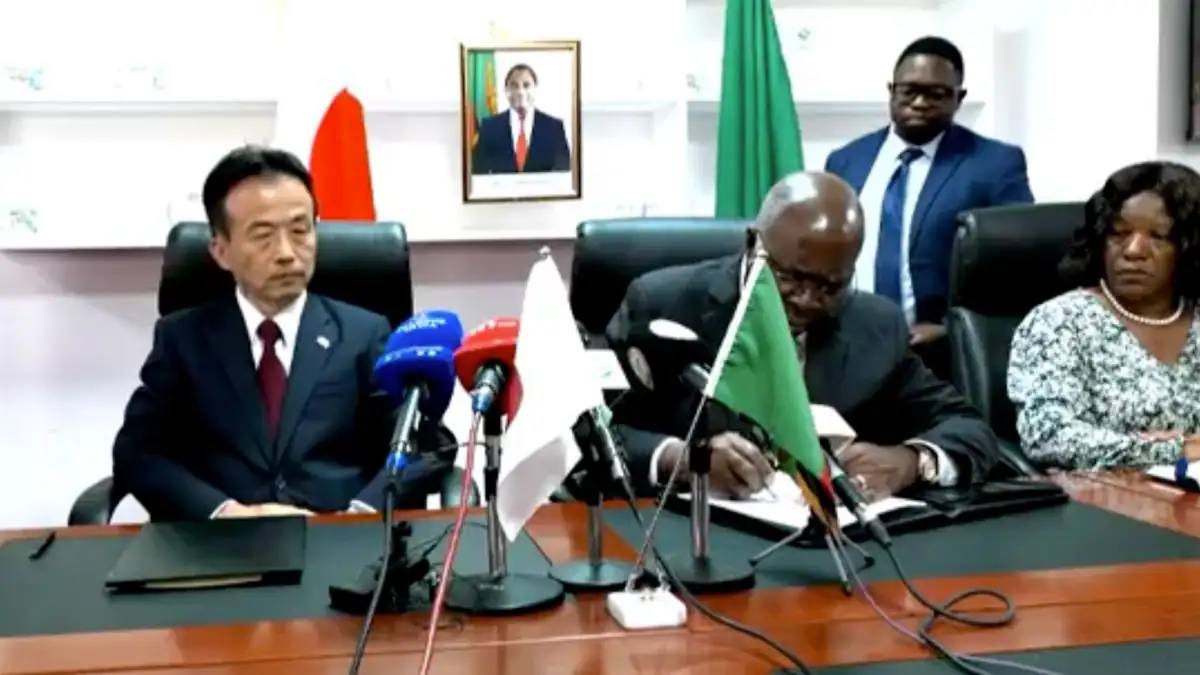
- The Exchange of Notes was signed in Lusaka on Thursday by Finance Minister Dr Situmbeko Musokotwane and Japanese Ambassador Mikami Akiteru.
- The grant adds to a run of rail financing this year, including a €50 million EU grant and a US$1.4 billion TAZARA partnership.
- Its real test will be whether Zambia Railways keeps the track in service once the new equipment arrives.
Zambia’s railways have received fresh support from Tokyo. The Government of Japan has committed a grant of ¥999 million, equivalent to about US$6.17 million, to help maintain the country’s rail network.
Dr Situmbeko Musokotwane, MP, Minister of Finance and National Planning, and Japan’s Ambassador to Zambia, Mikami Akiteru, signed the Exchange of Notes and Grant Agreement in Lusaka on Thursday. The ambassador said the money comes under Japan’s 2026 Grant Aid Project, the Economic and Social Development Programme, and will pay for railway maintenance equipment.
The yen amount is fixed. The dollar value moves with the exchange rate, which explains why the Japanese side put the grant at about US$6.3 million.
What the money is for
This is a grant, not a loan, so it adds nothing to Zambia’s debt. Its scope is narrow. It funds equipment to keep existing track in working order rather than new lines.
That focus is sensible. Zambia’s rail problem has long been less about routes on a map and more about the condition of the track that already exists. Poor track forces lower speeds, causes derailments and pushes shippers back onto the roads. Dr Musokotwane said the support would help Zambia Railways rehabilitate its track and systems and run its services more efficiently.
Why rail matters for trade
Moving bulk goods by rail is generally cheaper than by truck, and it spares the road network from heavy wear. For a landlocked country that exports copper and agricultural produce, transport cost feeds straight into competitiveness.
The minister linked the grant to the Grow Zambia Agenda and its push for export-led growth. Moving minerals and farm output to regional ports more cheaply, he argued, is central to that plan. That theme ran through his September outline of an export-led growth strategy.
Part of a larger rail push
The Japanese grant is small next to other recent commitments, but it fits a clear pattern. In June, Government said it had secured more than US$1.48 billion in rail deals and grants. That included a US$1.4 billion public-private partnership to rehabilitate the TAZARA line and a €50 million EU grant for track, signalling and telecommunications on the Livingstone to Copperbelt section.
In August, the African Development Bank approved a US$255 million loan and a US$10 million grant for Zambia’s part of the Lobito Corridor, which includes about 550 km of new railway.
Big corridor projects attract headlines. Maintenance decides whether a railway still works ten years later. Japan’s equipment grant sits in that less visible but necessary category.
The question that remains
Government wants Zambia to become a regional transport and logistics hub, given its position between several trade corridors. The grant supports that aim, and better rail capacity should, over time, draw more investment into the sector and support jobs along the supply chain.
The return will depend on execution. New equipment needs trained crews, spare parts and a maintenance budget that survives beyond the grant. Zambia reaffirmed its commitment to implement the project well and to deepen cooperation with Japan. Freight volumes on the line will show whether that commitment holds.
Related: Musokotwane Pivots Zambia Toward Export-Led Growth as Jobs and Investment Take Centre Stage.
Related: Zambia’s Q2 2026 Economy: Stability Deepens, the Growth Dividend Still Missing.
Related: Lobito Corridor Talks Open in Lusaka With a US$28 Billion Investment Pipeline on the Table.
WARNING! All rights reserved. This material and all other digital content on this website may not be reproduced, published, broadcast, rewritten, or redistributed, in whole or in part, without the prior express permission of The Zambian Economist. Where permission is granted, the content must be clearly credited to “The Zambian Economist,” with “www.zambianeconomist.com” prominently displayed.
WhatsApp: +260775574228 | Email: info@zambianeconomist.com
© 2026 The Zambian Economist.