Africa’s richest man has proved that African-led industrialisation can work at global scale. His next step should be the one Alfred Nobel took: a prize that outlives the fortune.
KEY TAKEAWAYS
- Aliko Dangote, Africa’s richest person with a Forbes estimated fortune of US$28.5 billion, has shown that large African-led industrialisation is possible.
- Alfred Nobel left about 94 per cent of his estate to an endowment whose returns still fund the Nobel Prizes, 130 years after his will was signed.
- Dr Kelvin Kamayoyo argues that a perpetual “Dangote Prize” for African innovation would outlast any refinery or cement plant.
- With the 2026/2027 El Niño expected to bring drought to much of southern Africa, he also calls for direct relief to affected communities now.
- Academia should study the Dangote business model as an African school of thought rather than rely on imported Western frameworks.
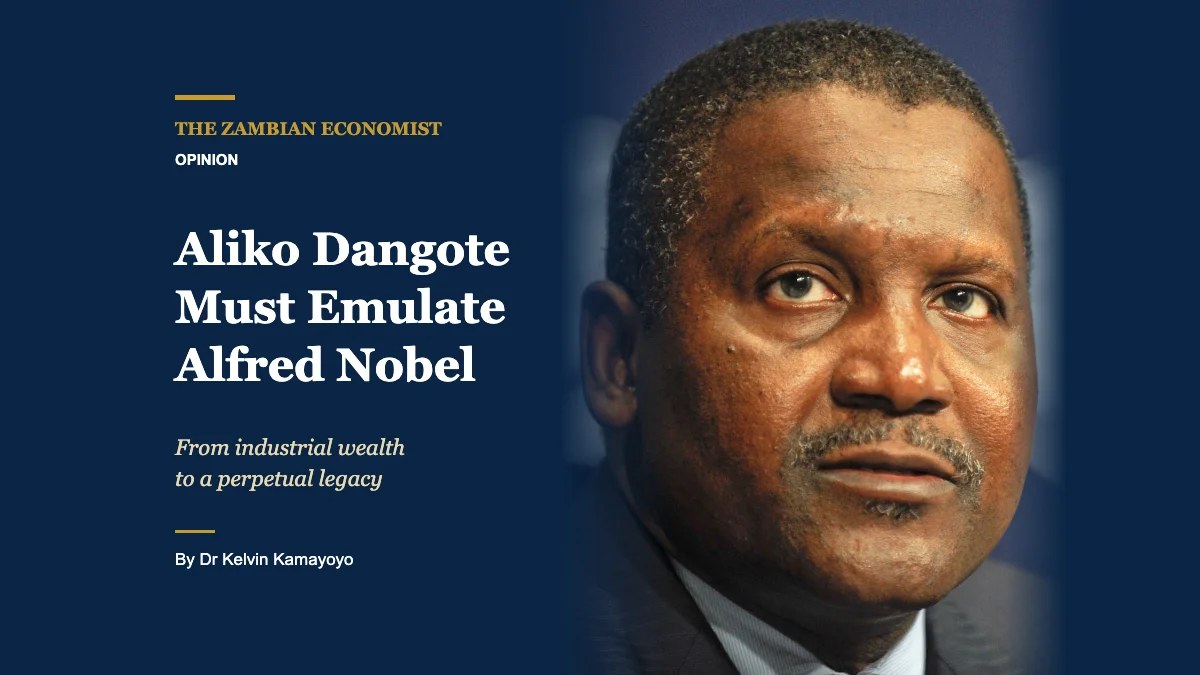
Aliko Dangote must emulate Alfred Bernhard Nobel and turn industrial wealth into a perpetual legacy.
Dangote’s achievements are admirable and motivate many people across Africa and beyond. Forbes ranks him as the continent’s richest person, with an estimated net worth of US$28.5 billion in its 2026 list (Forbes, 2026). He started a small trading business in Lagos in 1977. He went on to build Africa’s largest cement producer and to commission the 650,000 barrels-per-day Dangote Refinery in Lekki (Dangote Group, 2024). In doing so, he has shown that large-scale, African-led industrialisation is possible.
His journey is about more than accumulating wealth. It is about possibility, and about proving that an African can build at global scale from Africa.
Success as a story others can learn from
African literature has long understood this kind of motivational power. In Things Fall Apart (1958), Chinua Achebe traces how Okonkwo rises from his father’s poverty to prominence in Umuofia through hard work and resilience. Achebe also shows that personal success means little when it is cut off from the community that gives it meaning (Achebe, 1958). Dangote’s story carries the same double lesson.
What sets Dangote apart is his willingness to talk about how he built his fortune. He has spoken at investor forums, universities and policy roundtables about patient capital, reinvestment, managing debt and building despite poor infrastructure. Research on entrepreneurship finds that visible role models reduce the uncertainty that new entrants feel and make wealth creation seem learnable (Bosma et al., 2012).
To emulate, in this context, means to imitate a model and then surpass it. It is not blind copying. It is deliberate learning that turns admiration into a better, locally relevant legacy. That is what Dangote should do with Nobel. Dangote has not published any formal commentary on Nobel, but the stated purpose of his Aliko Dangote Foundation is close to Nobel’s final intent: that private fortune should ultimately serve the public (Bishop and Green, 2008).
How Nobel turned a fortune into a permanent institution
Alfred Nobel (1833 to 1896) was a Swedish chemist, engineer and industrialist. He patented dynamite in 1867, held 355 patents and built an international business in explosives and armaments, with interests in his brothers’ oil company in Baku (Fant, 1993).
According to a widely told account, a French newspaper mistook the 1888 death of his brother Ludvig for his own and ran an obituary describing him as “the merchant of death”. Historians have struggled to locate the original article, but the story captures a real concern: Nobel thought hard about how he would be remembered (Sohlman, 1983).
He signed his last will and testament on 27 November 1895 at the Swedish-Norwegian Club in Paris and died on 10 December 1896. The will left about 94 per cent of his estate, some 31 million Swedish kronor, to a fund whose annual returns would reward those who had “conferred the greatest benefit to humankind” (Nobel Foundation, 2024). Estimates put that sum at more than SEK 2 billion in today’s money. The prizes were to cover five fields: physics, chemistry, physiology or medicine, literature and peace. The Nobel Foundation was set up in 1900 to carry out the will (Lundestad, 2001).
Nobel’s achievement was threefold. He turned unease about his reputation into purpose. He made excellence universal rather than national, since the will specified that nationality should not count. And he made his legacy perpetual by creating an endowment rather than a one-off gift (Nobel Foundation, 2024). He understood that society needs lasting institutional incentives to honour those who move humanity forward.
The uncomfortable question
The question that follows is uncomfortable but necessary. What lasting, inspirational legacy will Aliko Dangote be remembered for in 2126 if he does not establish a “Dangote Prize Laureates” programme?
The Indian author Arundhati Roy has long argued that asking awkward questions is not disloyalty but a way of seeing clearly, because it strips away pretence so that a society can confront an issue honestly (Roy, 2008).
Factories can be nationalised. Refineries can become obsolete. Fortunes can be divided and diluted. A prize endures. In a hundred years, the Dangote Refinery may be a museum. A Dangote Prize for African Industrial Innovation, for Food Security, for Affordable Housing or for Energy Access could still be honouring African talent. Nobel understood that wealth without an institution to carry its purpose dies with its owner.
A challenge to African scholarship
To emulate Nobel, Dangote must institutionalise inspiration. That is also a challenge to academia. Scholars should spend more time analysing the business and investment models Dangote has used and test which of them work in African conditions. Management research on African business still leans heavily on models imported from the West (George et al., 2016).
Dangote’s approach combines vertical integration, backward integration into raw materials, the management of political risk and long-horizon domestic capital. It has drawn both praise and criticism. Akinyoade and Uche (2018), for example, examine how far close ties with the state shaped the growth of Dangote Cement. That debate is itself a reason for serious study. The approach deserves its own body of research, which might be called the Dangote Model of African Industrial Capitalism.
Legacy is also tested now
A prize is about the future, but legacy is also tested in the present.
The World Meteorological Organization expects the strengthening El Niño of 2026/2027 to bring drier conditions and drought risk to much of southern Africa, with above-normal temperatures across the region (WMO, 2026). The Intergovernmental Panel on Climate Change has found that El Niño events worsen food insecurity in vulnerable regions (IPCC, 2023). The last El Niño, in 2023/2024, left about 68 million people in the Southern African Development Community in need of help, according to SADC (SADC, 2024). Zambia declared a national disaster during that drought. For more on the current outlook, see our explainer, Understanding the ‘Supersized’ El Niño of 2026/2027, and Dr Kamayoyo’s earlier piece, Supersized El Niño 2026/2027 To Stress Rivers.
The Kenyan Nobel Peace laureate Wangari Maathai, founder of the Green Belt Movement, wrote that environmental damage and poverty feed each other, and that the burden falls hardest on the poor. Her answer was collective resilience: communities planting trees, protecting watersheds and supporting one another (Maathai, 2009). In that spirit, Dangote should consider donating food, children’s books, shoes, clothing and temporary shelter to communities hit by the 2026/2027 El Niño.
Where wealth meets morality
This is where wealth meets humanity. The Scottish-American industrialist Andrew Carnegie set out the duty plainly in his 1889 essay, later known as The Gospel of Wealth. He argued that the rich are trustees of their fortunes and should use them for the good of the community during their lifetimes, warning that “the man who dies thus rich dies disgraced” (Carnegie, 1889). That principle later shaped modern philanthropy, from Rockefeller to Gates (Bishop and Green, 2008). Wealth that does not feed, clothe and shelter people in a climate crisis loses moral legitimacy.
Literature has taught this lesson too. In Schindler’s Ark (1982), the Australian novelist Thomas Keneally tells the story of Oskar Schindler, an industrialist who turned his factory and fortune from war profiteering into a means of rescuing the people who worked for him (Keneally, 1982). Achebe’s No Longer at Ease (1960) returns to the tension between individual advancement and obligation to the community. Both writers show that wealth without moral responsibility destroys, and that wealth with a social conscience rebuilds.
Africa’s Schindler moment
Aliko Dangote has built what no other African has built. He has earned wide admiration. The next step is a kind of immortality: not of the body, but of purpose. Nobel turned dynamite into a peace prize. Dangote can turn cement and petrol into prizes for human progress.
Establishing the Dangote Prize Laureates would be Africa’s own Schindler moment, turning an industrial fortune into permanent moral capital. It would mean that in 2126, young African scientists, writers, industrialists and peacemakers still strive because Dangote once lived. That legacy would be worth more than being the richest person on the continent.

About the author
Dr Kelvin Kamayoyo
Economist, International Trade Law Scholar and Investment Consultant | Lusaka, Zambia
Dr Kelvin Kamayoyo has over 13 years of experience across academia, policy and the private sector. He is Programme Director of the Purposive Mega-Infrastructure Investment Programme and Technical Advisor for African Rivers, and an adjunct lecturer at ESAMI, NIPA and Zambia Open University. A former board member of the Economics Association of Zambia, he writes on economics, international trade, local content, river ecosystems and climate change. He can be reached at kamayoyokm@gmail.com. Meet our contributors.
References
- Achebe, C. (1958) Things Fall Apart. London: Heinemann.
- Achebe, C. (1960) No Longer at Ease. London: Heinemann.
- Akinyoade, A. and Uche, C. (2018) ‘Development built on crony capitalism? The case of Dangote Cement’, Business History, 60(6), pp. 833 to 858.
- Bishop, M. and Green, M. (2008) Philanthrocapitalism: How the Rich Can Save the World. New York: Bloomsbury Press.
- Bosma, N., Hessels, J., Schutjens, V., Van Praag, M. and Verheul, I. (2012) ‘Entrepreneurship and role models’, Journal of Economic Psychology, 33(2), pp. 410 to 424.
- Carnegie, A. (1889) ‘Wealth’, North American Review, 148(391), pp. 653 to 664.
- Dangote Group (2024) Annual Report 2023. Lagos: Dangote Industries Limited.
- Fant, K. (1993) Alfred Nobel: A Biography. New York: Arcade Publishing.
- Forbes (2026) The World’s Billionaires 2026. New York: Forbes Media.
- George, G., Corbishley, C., Khayesi, J.N.O., Haas, M.R. and Tihanyi, L. (2016) ‘Bringing Africa in: Promising directions for management research’, Academy of Management Journal, 59(2), pp. 377 to 393.
- IPCC (2023) Climate Change 2023: Synthesis Report. Geneva: Intergovernmental Panel on Climate Change.
- Keneally, T. (1982) Schindler’s Ark. London: Hodder and Stoughton.
- Lundestad, G. (2001) ‘The Nobel Peace Prize’, in The Nobel Prize: The First 100 Years. London: Imperial College Press.
- Maathai, W. (2009) The Challenge for Africa. New York: Pantheon Books.
- Nobel Foundation (2024) Alfred Nobel’s Will. Available at: https://www.nobelprize.org/alfred-nobel/alfred-nobels-will/ (Accessed: 23 October 2026).
- Roy, A. (2008) The Shape of the Beast: Conversations with Arundhati Roy. New Delhi: Penguin Books.
- SADC (2024) Regional Humanitarian Appeal in Response to the 2023/2024 El Niño-Induced Drought and Floods. Gaborone: Southern African Development Community.
- Sohlman, R. (1983) The Legacy of Alfred Nobel. London: Bodley Head.
- WMO (2026) ‘El Niño will unleash multiple hazards in South-West Indian Ocean region’, 1 October. Geneva: World Meteorological Organization.
Related reading: Africa Must Prepare Now for the Unrelenting 2026 El Niño Wave.
WARNING! All rights reserved. This material and all other digital content on this website may not be reproduced, published, broadcast, rewritten, or redistributed, in whole or in part, without the prior express permission of The Zambian Economist. Where permission is granted, the content must be clearly credited to “The Zambian Economist,” with “www.zambianeconomist.com” prominently displayed.
WhatsApp: +260775574228 | Email: info@zambianeconomist.com
© 2026 The Zambian Economist.