

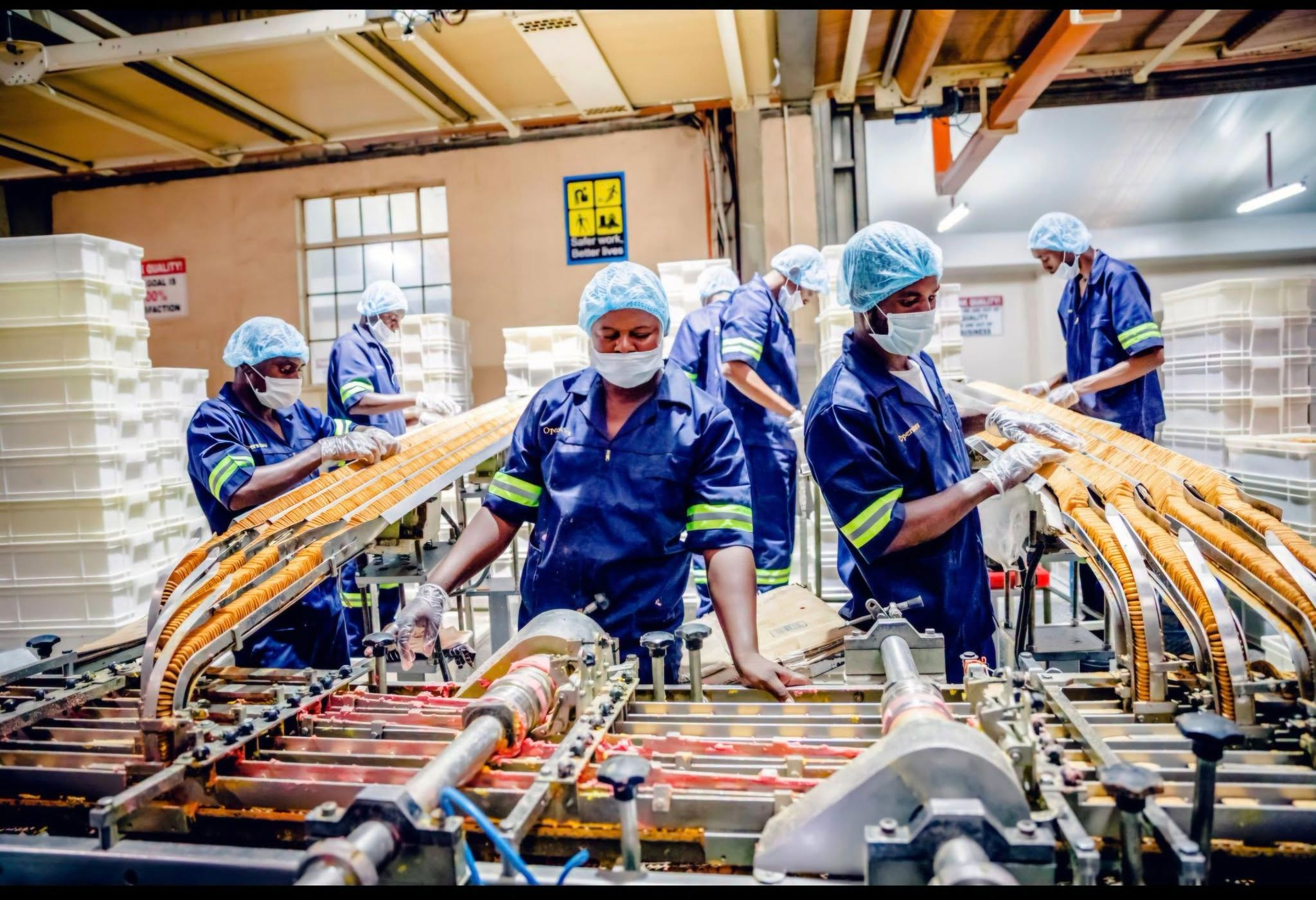
The President’s manufacturing priorities put economic zones, value addition and local buying at the centre of industrial growth. Delivery will depend on whether Zambian firms can produce competitively and reach paying customers.
Key Takeaways
- The supplied policy briefing identifies stronger Multi-Facility Economic Zones, value addition and support for local production as manufacturing priorities.
- Reducing business costs and expanding export markets are intended to help Zambian producers compete.
- The briefing provides no new funding allocation, implementation timetable or quantified employment target.
- Progress should be assessed through operating factories, local supplier orders, sustained jobs and manufactured exports.
Zambia’s manufacturing vision seeks to turn more locally available raw materials into finished and semi-finished goods, creating employment and widening the country’s export base. The policy briefing supplied under the heading “Unpacking the President’s Vision” sets out five priorities, from strengthening economic zones to lowering the cost of doing business.
For households, the potential benefit is paid work in factories and the businesses that supply them. For entrepreneurs, it is a chance to sell inputs, packaging and services to producers. Those gains depend on factories securing orders and covering their costs; a policy commitment alone cannot establish how many jobs will follow.
What does the manufacturing vision propose?
| Priority in the briefing | What delivery would need to demonstrate |
|---|---|
| Strengthen Multi-Facility Economic Zones (MFEZs) | Investment moving into operating production facilities and sustained employment. |
| Promote value addition | More commercially viable processing of local raw materials. |
| Support local production through the Proudly Zambian Campaign | Repeat purchases and supplier contracts for competitive local goods. |
| Reduce the cost of doing business | Lower production and compliance costs, with predictable services. |
| Expand export markets | Orders, successful deliveries and payment from customers abroad. |
The second column sets out this publication’s assessment of useful delivery tests. These are not additional government commitments.
Economic zones need working factories and local suppliers
The Ministry of Commerce, Trade and Industry describes its MFEZ programme as a means of increasing manufacturing activity and processing Zambia’s natural and agricultural raw materials for domestic and export markets.
For a manufacturer considering a zone, the practical questions include the reliability of electricity and water, transport access and the cost of bringing production equipment into use. An investment announcement is an early step. An operating factory with customers is stronger evidence of industrial development.
Local businesses also need a route into those factories’ purchasing systems. Clear product specifications, transparent supplier selection and manageable payment terms would help smaller Zambian firms compete for contracts. Zone investment would have a wider domestic benefit if it generated orders beyond the factory gate.
Value addition must earn more than it costs
Processing agricultural produce into packaged food, or turning mineral inputs into manufactured products, can retain more production activity in Zambia. These are examples of possible value chains, rather than projects announced in the supplied briefing.
The commercial test is whether the selling price covers the additional cost of machinery, power, labour and distribution. Investors need to assess demand alongside the availability of raw materials. A processing plant without dependable buyers can struggle even when its inputs are locally available.
Workers would benefit most where investment supports skills that employers actually need, with safe conditions and jobs that last beyond a construction phase.
What does buying Zambian mean for consumers?
The Proudly Zambian Campaign promotes the production and consumption of quality local goods and services. The briefing places it within the effort to strengthen domestic production.
Consumer confidence will depend on consistent quality, availability and price. A local brand needs to win repeat purchases. For producers, that means reliable delivery and after-sales support where relevant, as well as a recognisable label.
Local production does not automatically make goods cheaper. Imported equipment or packaging may remain part of a factory’s costs. Households will judge the result at the shop counter.
Export access must become export sales
The briefing identifies AfCFTA, COMESA and SADC as routes to wider regional markets, and also seeks stronger commercial links across the Commonwealth. These should not be treated as interchangeable arrangements. The Commonwealth’s Connectivity Agenda, for example, supports cooperation and exchange of experience on trade and investment.
For an individual exporter, the relevant questions are product standards, applicable market-entry requirements and the cost of delivery. Access to a market creates an opportunity; a business still has to find a buyer and fulfil the order. A Zambian food processor seeking regional customers needs dependable output and packaging that meets the destination’s requirements.
How should Zambia measure industrial progress?
The supplied briefing does not specify a new financing package, delivery dates or the number of jobs expected. It therefore describes policy direction rather than a costed implementation programme.
A useful public scorecard would report how many supported factories are operating, their sustained employment and purchases from Zambian suppliers. Manufactured export sales and production costs would help show whether competitiveness is improving. Clear baselines would make changes easier to assess.
For businesses, the immediate task is to identify a product and customer, then establish what financing, infrastructure and certification are required to supply that customer profitably. For policymakers, the test is whether the stated priorities remove obstacles along that route.
The vision’s value will become visible in production that can sustain itself: Zambian firms winning repeat orders, workers keeping paid jobs and households finding local goods worth buying.
Sources: supplied “Unpacking the President’s Vision” manufacturing briefing; Ministry of Commerce, Trade and Industry materials on MFEZs and the Proudly Zambian Campaign; Commonwealth Connectivity Agenda. Economic implications and proposed delivery tests are The Zambian Economist’s analysis.
Explore our Business & Economy coverage and Macroeconomy & Policy reporting. Related: Musokotwane’s case for productive investment and private-sector growth and ZESCO, skills retention and sustainable remuneration.
WARNING! All rights reserved. This material and all other digital content on this website may not be reproduced, published, broadcast, rewritten, or redistributed, in whole or in part, without the prior express permission of The Zambian Economist. Where permission is granted, the content must be clearly credited to “The Zambian Economist,” with “www.zambianeconomist.com” prominently displayed.
WhatsApp: +260775574228 | Email: info@zambianeconomist.com
© 2026 The Zambian Economist.
Work With The Zambian Economist
Advertise With Us | List With Us | Submit an Article
Related energy coverage: Zambia backs preparations for African Hydro Symposium on climate resilience.
Related analysis: After the money: what foreign funding should leave behind in Zambia.
Related tax coverage: EAZ calls for clear tax rules and measurable reforms at the HLB Tax Indaba.