
The 2027 Budget sets out bold targets for copper, maize and power. Lewis Chingi argues that too much of the bill lands on the Zambian household, the very spending that keeps the economy turning.
KEY TAKEAWAYS
- The 2027 Budget raises VAT from 16 to 16.5 percent, adds a 39.5 percent top PAYE band, and introduces new duties on sugar, cooking oil inputs and mobile money transfers, with Treasury expecting about K10.8 billion in extra revenue.
- Debt service takes K67.6 billion of the K284.8 billion budget, nearly a quarter of all spending.
- The speech and its annex of revenue measures give different figures for the new PAYE threshold, company tax and ceramic tile duty.
- CDF rises to K9.0 billion, yet each constituency still receives K40 million.
- Chingi asks Government to delay the VAT rise and the new PAYE band, index tax bands to inflation, clear K60.3 billion in VAT refunds and K51.4 billion in supplier arrears, and reform the CDF formula now.
Every farmer in this country knows the rules about seed. You can be hungry in December, and you still do not touch the bag you set aside for planting. Eat it, and there is no harvest next year. It is as simple as that.
That rule kept coming back to me as I read through the 2027 Budget speech that the Minister of Finance, Dr Situmbeko Musokotwane, delivered to Parliament on Friday.
Let me say first that there is a lot in that speech I like. Three million tonnes of copper by 2031, ten million tonnes of maize, 10,000 megawatts of power. Who would argue with any of that? If even half of it happens, my children will grow up in a very different Zambia. My worry is about who has been asked to pay for it, and when.
Strip the speech down and the answer is the household. VAT goes from 16 to 16.5 percent. There is a new top PAYE band of 39.5 percent. Sugar picks up a duty of K1 a kilo, sending money by mobile money will cost more, passports will cost more, and the list goes on. Treasury expects all this to bring in about K10.8 billion next year. I would argue that a good part of that money is seed. It is what families would otherwise have spent at the market, the hardware shop and the school gate, and it is that spending that keeps small businesses open and people at work.
I should declare an interest before going any further. I am one of the people this new 39.5 percent band will reach. But this article is not about my payslip. The person I worry about more is the woman who will never come anywhere near that band yet will feel the extra half point of VAT every single time she buys sugar or cooking oil.
The lake behind the dam
We all lived through 2024. Kariba didn’t break. The turbines were fine. There just wasn’t enough water in the lake, and for months we arranged our lives around load-shedding schedules.
I think of household spending in much the same way. It is the water that turns the economy’s turbines. When people have money they spend it, shops restock, suppliers get paid, and somebody somewhere keeps a job. Every new tax lets a little of that water out. And right now, the lake is already low.
The speech says as much, if you read it carefully. Oil went from US$64.6 a barrel in January to US$114 by October, and Government had to suspend VAT and excise duty on fuel to keep pump prices from running away. In the same document, the Minister commits to keep moving electricity towards “cost-reflective tariffs”, which in plain language means ZESCO bills are going up.
Inflation is down to 6.3 percent from 11.2 percent last December, and I give Government credit for that, because it took real work. But a lower inflation rate only means prices are climbing more slowly. Nobody’s meals got cheaper. Whatever a family was paying in 2021 for a bag of breakfast, a litre of oil or a minibus fare has been climbing ever since, and none of it has come back down.
Here is the figure that bothered me most. Out of a K284.8 billion budget, K67.6 billion goes to servicing debt. That is nearly a quarter of everything. So, when the Minister asks us for another K10.8 billion, I find myself asking whether we are funding tomorrow’s growth or paying off yesterday’s loans. From where I sit, it looks a lot like the second.
Under the streetlight
Now to the 39.5 percent band, which is the part that has caused the most noise.
Today the top rate is 37 percent on monthly income above K9,200. From January, income above K37,000 a month will be taxed at 39.5 percent. Government’s defence is that this touches very few people, and only on the portion above the line. That is fair as far as it goes. On its own, 2.5 points come to K25 on every K1,000.
The trouble is that it never comes on its own. The same worker will pay more tax on the house or car her employer provides. She pays higher VAT, a higher mobile money levy and the new sugar duty. Take the next K100 she earns above the threshold. PAYE costs K39.50. She spends the K60.50 that is left, and about K8.50 of that goes back to Government as VAT. Roughly K48 of her K100 is gone, and we haven’t even counted fuel, tolls or council fees. At that point the State starts to feel less like a partner in your progress and more like a landlord collecting rent on it.
People also forget what a K37,000 salary means in Zambia. It is almost never one person’s money. Think of someone like Salipako, an engineer on the Copperbelt. His salary pays his children’s school fees, his nephew’s college fees, his mother’s medicine back home in Mwinilunga, a maid, a guard, and something towards every funeral in the extended family. Tax Salipako harder and you are really taxing a dozen people who will never appear on a ZRA return.
You know the story of the man looking for his keys under a streetlight? Someone asks him if that is where he dropped them. “No,” he says, “but this is where the light is.” People on PAYE live under the streetlight. Their tax is gone before the salary even reaches the bank, so ZRA never has to go looking for them. That makes them easy to tax. Whether taxing them is fair is a different question altogether.
They also have options. A doctor or an engineer who feels squeezed enough can take a contract in Gaborone, turn into a “consultant” overnight, or quietly declare less. Britain learnt that lesson the hard way in the 1970s, which I will come back to.
What the Constitution says
I want to be careful here, because this is where the debate tends to get loud.
Article 198 of our Constitution, as amended in 2016, lays down the principles of public finance. One of them is that the burden of taxation must be shared fairly. Another is that money raised nationally should be shared equitably among the different levels of government. Article 8 lists equity and social justice among our national values, and Article 9 says those values must guide Parliament whenever it makes a law. Article 1 leaves no doubt that the Constitution sits above every other law in the land.
Fair doesn’t mean equal. Nobody sensibly thinks a cleaner and a mine manager should pay the same tax, and I am not arguing that. A progressive system, where those who earn more pay a bigger share, is perfectly constitutional. My argument is about balance. Does the burden match what people can afford once you account for the cost of living and the relatives they carry? Is it spread across everyone who can pay, or piled onto the people who are easiest to catch? And can an ordinary citizen read the law and know exactly what it expects of him?
On that last question the Budget has a real problem. The speech says the 39.5 percent band starts at K37,000 a month. The annex of revenue measures at the back says K34,000. The speech says company tax goes up by five points on income currently taxed at 20 percent and below, while the annex says anything taxed below 30 percent. On ceramic tiles, the speech says duty rises from 25 percent, and the annex says from 5. Which is it, Honourable Minister? If the Ministry cannot give the same number twice in one document, how is the taxpayer meant to plan?
The Budget does widen the net in places, and I should say so. A 15 percent tax on mining dividends is long overdue, and so is the push to bring gold trading out from under the table. But most of the new weight still lands on the payslip and the shopping basket.
Taken together, I believe these measures fall short of what Article 198 demands of Government. That is my opinion and I hold it firmly. The courts have the final word, and Article 128(3) allows anyone who believes an Act of Parliament breaches the Constitution to petition the Constitutional Court. When the Finance Bills come to the House, I hope our MPs will at least ask themselves whether they could defend these measures in that courtroom.
Half a point of VAT
Half a percentage point sounds like nothing. It isn’t nothing if you spend every ngwee you earn.
That is the thing about VAT. A family with savings pays it only on what it spends. A family with no savings pays it on everything, so the poorer you are, the bigger the share of your income it takes. Economists call that regressive. Most people just call it life getting harder.
And the VAT increase doesn’t arrive alone. There is the K1 a kilo on sugar, and a new duty and surtax on the crude oils our factories turn into cooking oil. There is 80 ngwee on every plastic bottle, and a bigger mobile money levy, which hurts the marketeer at Chisokone and the grandmother in Kabompo waiting for money from town far more than anyone with a bank account. Energy-saving appliances lose their tax relief too, barely a year after we spent months in the dark. Each of these can be explained on its own. Put them all in the same shopping basket and the basket gets very heavy.
The social cash transfer goes up from K400 to K450 a month, which I welcome. I just wonder how much of that K50 will survive a trip to the shop.
One shoe for a baby and his father
Then there is the CDF.
The headline is a jump to K9.0 billion from K6.2 billion. Read a little further and you find that each constituency still gets K40 million, because the extra money is mostly going to the new constituencies. For any individual constituency, nothing changes.
Giving every constituency the same K40 million is like buying one shoe size for a baby and his father. One trips over it and the other can’t get his foot in. A small urban constituency with tarred roads and a hospital nearby simply does not have the same needs as Zambezi West or Mwinilunga, where one bridge can eat the whole year’s allocation and a clinic may be a day’s walk from some of the villages it serves.
What puzzles me is that the Minister seems to agree. Further on in the same speech, he says constituencies differ and promises to review the formula so that it reflects equity and not just equality. So why not start in 2027? With prices rising every year, a K40 million that never moves is quietly worth a little less each time. I would call that a sustained absurdity, and I don’t think the phrase is too strong. Article 198 asks that national revenue be shared equitably between levels of government, and here we are being asked to pay more tax into a sharing formula that Government itself admits is unfair.
We have seen this before
History is full of governments that believed they could squeeze just a little more.
In 1696 England brought in a tax on windows. The more windows your house had, the more you paid, so people bricked them up. The tax raised less than hoped, homes became dark and damp, and it was not abolished until 1851. You can still spot the bricked-up windows on old English houses. Tax formal income too hard and something similar happens. People find ways to show less of it.
Britain tried again in the 1970s, with a top rate of 83 percent on earned income and 98 percent on investment income. Skilled people left and took their money with them, and from 1979 the rates came down sharply. In Sweden in 1976, Astrid Lindgren, the author of Pippi Longstocking, worked out that her marginal tax rate was over 100 percent. She wrote a satirical fairy tale about it, Pomperipossa in Monismania, and the uproar it caused is often mentioned as one reason the Social Democrats lost power later that year, for the first time in over four decades.
Someone will say that Sweden and Norway tax heavily and are rich anyway. True. But they got rich first, and their people can see what the taxes buy: hospitals with medicine, schools with teachers, and pensions paid on time. Here, a professional on 39.5 percent will still pay for private medical cover, a solar system for when the power goes, a borehole and private school fees. He is paying for public services twice. I honestly don’t know what to call that except a toll.
What I would ask the Minister to do
I don’t want to only complain, so let me be practical.
- Pace the burden. Hold back the VAT increase until inflation has stayed within the 6 to 8 percent band for a full year, and give energy-saving appliances back their relief while we are still rebuilding our power supply. Adjust the PAYE bands for inflation every year, so nobody is pushed into a higher bracket simply because prices went up, and hold off on the 39.5 percent band until the cost of living settles. And please fix the gaps between the speech and the annex before the Finance Bills are tabled.
- Widen the net before tightening it. The Budget already has good ideas: formal gold trading, the mining dividend tax, digital land records, and the e-Council system, which collected over K290 million in six months from just eight councils during its pilot. Imagine that rolled out across every council before anyone touches the payslip again.
- Pay what Government owes. The speech itself admits to K60.3 billion in outstanding VAT refunds and K51.4 billion in arrears to suppliers. That money should be sitting in Zambian businesses, paying wages. Settle it, and the economy gets a lift without a single new tax.
- Fix the CDF formula now. Weigh it by population, distance and poverty. The consultations can go on while the money is already going where it is needed.
I meant what I said at the start. Grow Zambia is a good plan and I want it to work. But it is people who grow an economy: the farmer, the marketeer, the miner, the nurse, the teacher, the young engineer just starting out. Leave enough money in their pockets and they will spend it here, invest it here and plant it here.
Think back to that farmer and his bag of seeds. He isn’t keeping it because he has plenty to eat. He keeps it because he knows next year depends on it. All I ask is that the Minister show the same patience with the Zambian household.
Let Zambians grow, and Zambia will grow.
Related coverage How everyday purchases help finance the national budget · Moody’s lifts Zambia to Caa1 days before the 2027 Budget · Growing Zambians, not just Zambia · Lewis Chingi on Zambia’s reserved-seat rules
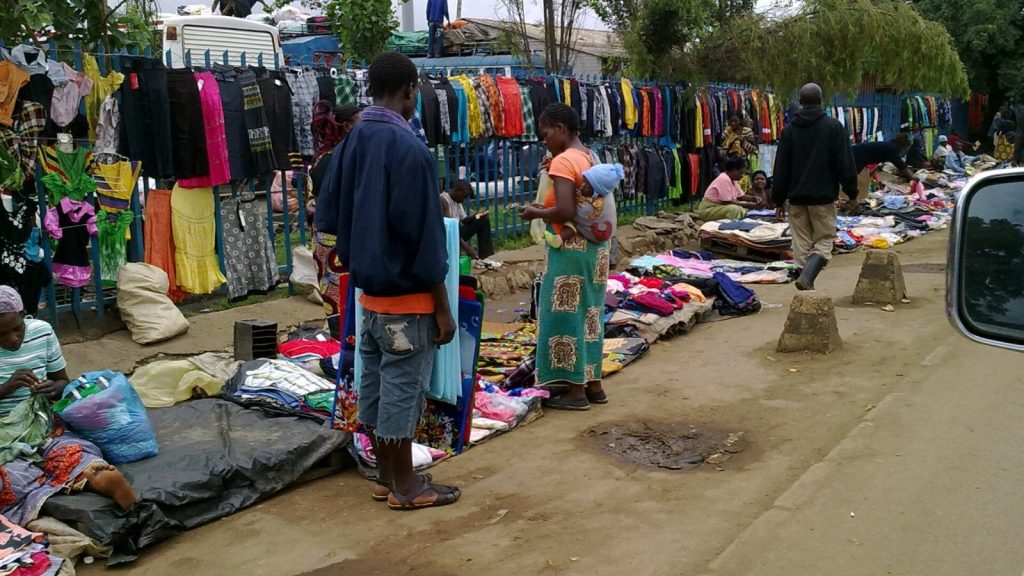
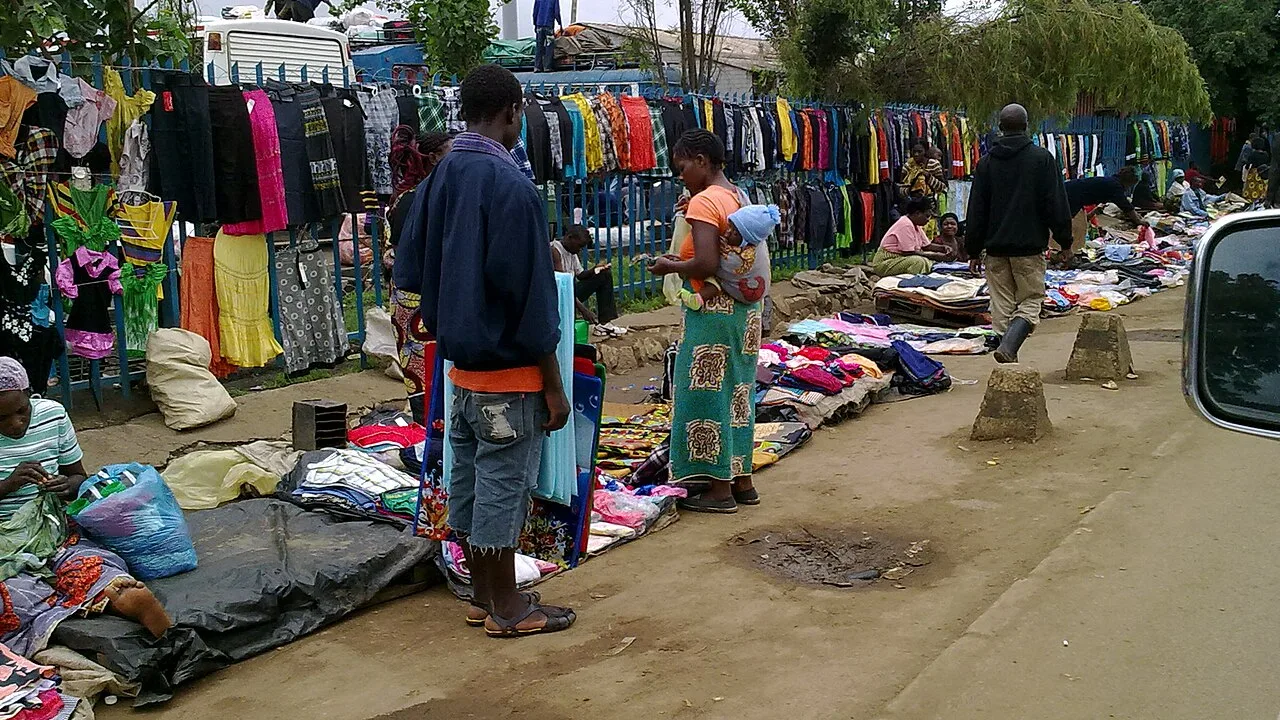
Featured photograph: A market in Lusaka, Zambia. Photo by SuSanA Secretariat, CC BY 2.0.
References
- Musokotwane, S. (2026) 2027 Budget Address, delivered to the National Assembly of Zambia, 6 November 2026. Lusaka: Ministry of Finance and National Planning.
- Constitution of Zambia (Amendment) Act No. 2 of 2016, Articles 1, 8, 9, 128 and 198.
- Zambia Revenue Authority, PAYE tax bands for 2026.
WARNING! All rights reserved. This material and all other digital content on this website may not be reproduced, published, broadcast, rewritten, or redistributed, in whole or in part, without the prior express permission of The Zambian Economist. Where permission is granted, the content must be clearly credited to “The Zambian Economist,” with “www.zambianeconomist.com” prominently displayed.
WhatsApp: +260775574228 | Email: info@zambianeconomist.com
© 2026 The Zambian Economist.