By Zambian Economist Analyst
Zambia’s economy grew 7.7% in the first quarter of 2026, the fastest quarterly expansion the country has posted in years. With the general election two weeks away, that number is already turning up in campaign rhetoric on every side. What it will not automatically turn up in is a smaller mealie meal bill, a busier stall in Kamwala, or a job offer for a graduate in Chelstone. Growth and household welfare are related, but they are not the same thing, and the gap between them is one of the most misunderstood numbers in Zambian public debate. This is a non-partisan, numbers-first look at why.
The number, and where it actually came from
Gross Domestic Product (GDP) measures the total value of goods and services produced in the economy. When ZamStats reports “real” growth, it means the number has already been adjusted to strip out the effect of rising prices, so 7.7% reflects an actual increase in the volume of economic activity, not just higher prices for the same output.
According to the Zambia Statistics Agency’s 25 June 2026 release, GDP grew 7.7% year-on-year in the first quarter of 2026, compared with 4.5% in the first quarter of 2025 and just 1.6% in the final quarter of 2025. That is a sharp acceleration by any measure.
Context matters here. ZamStats’ preliminary figures put full-year 2025 growth at 3.8%, the same pace as 2024, with the final 2025 number due alongside the Q2 2026 release in September. The World Bank, using its own estimation methods, put 2025 growth closer to 4.6%. The two are not a contradiction, they are different institutions, using different data vintages, measuring the same economy. For 2026 as a whole, the IMF forecasts 4.3% growth and the World Bank projects an average of 5.3% a year between 2026 and 2028. Both are well below the 7.7% Q1 print, which is the first sign that one strong quarter should not be read as the new normal.
The debt picture has also genuinely improved. Public debt fell from 133.4% of GDP in 2023 to roughly 93.4% in 2025, following restructuring agreements covering close to 94% of Zambia’s external debt, a real, measurable outcome of the post-2020 default process, not a campaign claim.
Why one strong quarter needs a health warning
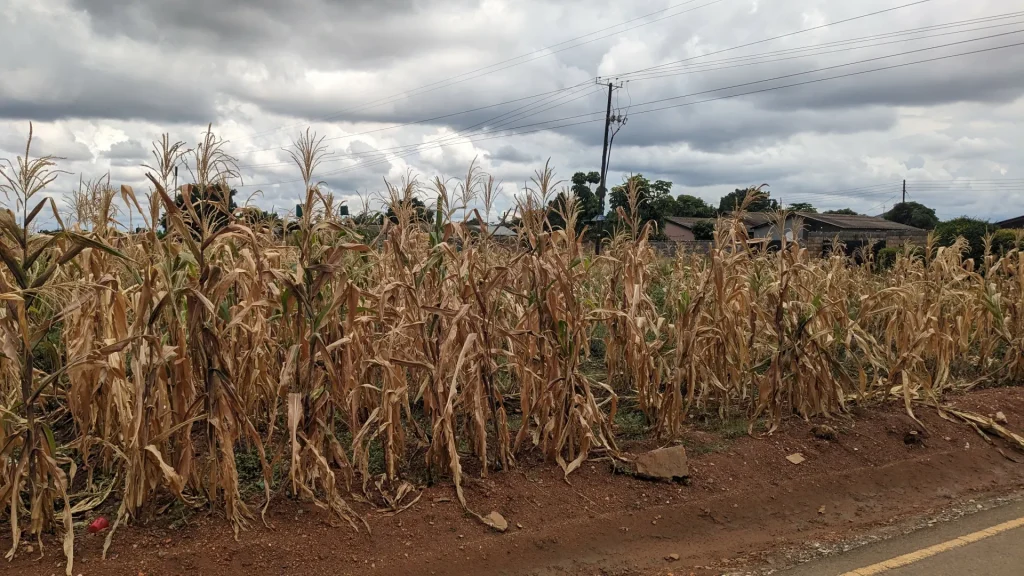
Most of the acceleration traces back to agriculture recovering from the 2024 drought, one of the worst in decades, which depressed output through much of 2025. Agriculture, forestry and fishing grew 21.4% in Q1 2026 and alone contributed 1.9 percentage points of the total 7.7% expansion, ZamStats says. That is a rebound off a very low base, not new productive capacity coming on stream. Economists call this a base effect: when last year’s number was unusually weak, this year’s percentage change looks unusually strong even if the underlying level of activity has only returned to where it used to be.
None of this makes the number fake. Zambian farmers genuinely produced more. But it does mean the 7.7% headline is doing more work describing a recovery from a bad year than it is describing a structurally faster-growing economy.
What actually grew in the first quarter
ZamStats breaks GDP growth down by industry. The picture is broader than agriculture alone, though agriculture did the heavy lifting:
| Sector | Q1 2026 growth (y/y) |
|---|---|
| Arts, entertainment and recreation | 21.7% |
| Agriculture, forestry and fishing | 21.4% |
| Information and communication | 11.0% |
| Transportation and storage | 9.5% |
| Accommodation and food service | 9.1% |
| Wholesale and retail trade | 6.7% |
| Financial and insurance activities | 5.8% |
| Manufacturing | 5.4% |
| Construction | 4.8% |
| Education | 3.7% |
| Real estate activities | 3.7% |
| Human health and social work | 3.3% |
Source: ZamStats, GDP First Quarter 2026 release, 25 June 2026.
One omission is worth noting. Mining and quarrying remained Zambia’s single largest sector by value, accounting for 14.8% of total GDP, but it did not appear among the industries ZamStats listed as positive growth drivers this quarter. For an economy whose growth story is so often told through copper, that is a meaningful nuance: the fastest-growing parts of the economy right now are farms, transport operators, hotels and telecoms, not the mines.
What this looks like on the ground
For a trader restocking a stall in Kamwala, wholesale and retail trade grew 6.7% in volume terms, real, but modest, and easily eaten into by day-to-day costs once rent, transport and supplier prices are factored in.
For a farmer in Mkushi, the agriculture rebound is the most direct route to feeling this growth, if the harvest converts into a fair farm-gate price. That is not guaranteed automatically: a bigger national harvest can, on its own, push prices down unless the Food Reserve Agency’s buying keeps pace, a dynamic explored in our coverage of the 2026 FRA floor price and the opening of FRA depots this season.
For a graduate looking for work, GDP growth is the wrong number to watch in isolation. ZamStats does not publish an employment figure anywhere near as frequently as it publishes GDP, so there is a genuine data gap between “the economy grew” and “jobs were created.” That gap should be flagged honestly rather than assumed away in either direction.
The number households actually feel: inflation
Growth is an abstraction; prices are not. Annual inflation was 6.5% in June 2026, down from 6.6% in May, with food inflation at 6.7%, according to ZamStats. That is a genuine improvement on the double-digit inflation of late 2025, and our explainer on what Zambia’s 2026 inflation numbers actually show and the preview of the July print track this in more detail. But a slower rate of price increases is not the same as prices falling, it means the cost of living is still rising, just less quickly than before.
Common mistakes when reading this number
- Treating one quarter as the year. 7.7% is a Q1 year-on-year figure. The IMF’s full-year 2026 forecast is 4.3%.
- Confusing a sector’s growth rate with its size. Arts and entertainment grew fastest, but agriculture contributed far more to overall growth simply because it is a much bigger part of the economy.
- Ignoring the base effect. Comparing against a drought-hit 2025 flatters the 2026 number.
- Assuming growth is evenly spread. A national average can rise sharply while specific provinces, sectors or income groups see little change.
Who feels this, and who is still waiting
Most exposed to the upside: agriculture-dependent households in good-rainfall provinces, agro-processors, and transport operators moving farm produce. Least exposed, at least so far: urban wage earners whose kwacha incomes are fixed in nominal terms and eroded by even a lower inflation rate, and jobseekers in sectors where output growth has not obviously translated into hiring.
- ZamStats’ July 2026 inflation print, due around this time, will show whether the disinflation trend held.
- Q2 2026 GDP estimates, expected alongside the final 2025 annual GDP figure in September 2026.
- The Bank of Zambia’s next Monetary Policy Committee decision, see what the policy rate means for your loan.
- The 13 August election result and what the next government inherits on the economic front.
None of this is a case for cynicism about the numbers, and none of it is a case for taking them at face value either. Zambia’s economy did genuinely expand in the first quarter, on the back of a real agricultural recovery and broad-based services growth. Whether that shows up in a household’s monthly budget depends on which sector that household depends on, how quickly disinflation continues, and what the labour market data, still the missing piece, eventually shows.
Zambian Economist will keep tracking the GDP, inflation and labour market releases as they land through the rest of the election period, with the same non-partisan, source-first approach as this piece. Follow along for the Q2 numbers in September, and for the July inflation print in the days ahead.
What was Zambia’s GDP growth rate in the first quarter of 2026?
7.7% year-on-year, according to ZamStats’ 25 June 2026 release, up from 4.5% in Q1 2025 and 1.6% in Q4 2025.
Why did GDP grow so fast in Q1 2026?
Mainly a rebound in agriculture, forestry and fishing (up 21.4%) as the sector recovered from the 2024/25 drought, alongside broad growth across services such as ICT, transport and accommodation.
Is 7.7% growth expected for the whole of 2026?
No. The IMF forecasts 4.3% growth for full-year 2026, and the World Bank projects an average of 5.3% a year between 2026 and 2028, both below the Q1 pace, since a single quarter’s year-on-year figure is not the annual average.
Does GDP growth mean prices are falling?
No. GDP growth and inflation are separate measures. Annual inflation was 6.5% in June 2026, still rising, just more slowly than in late 2025.
How much has Zambia’s public debt fallen?
From about 133.4% of GDP in 2023 to roughly 93.4% in 2025, after restructuring agreements covering close to 94% of external debt.
Which sector grew fastest in Q1 2026?
Arts, entertainment and recreation posted the highest growth rate (21.7%), though agriculture contributed the most to overall GDP growth given its larger size in the economy.
Did mining drive the Q1 2026 growth number?
Not primarily. Mining and quarrying remained Zambia’s largest sector by value (14.8% of GDP) but was not listed by ZamStats among the quarter’s fastest-growing industries.
When is Zambia’s next GDP release?
Q2 2026 estimates are expected around September 2026, alongside the final 2025 annual GDP figure.
What is the difference between real and nominal GDP growth?
Real GDP growth strips out the effect of price changes, showing the actual change in the volume of goods and services produced. Nominal growth includes price effects and can overstate how much the economy has actually expanded.
Does the GDP number tell us whether jobs were created?
Not directly. ZamStats does not publish employment data as frequently as GDP data, so there is a genuine gap between confirmed output growth and confirmed job creation that current data cannot fully close.
Where can I check these figures myself?
The Zambia Statistics Agency (zamstats.gov.zm) publishes GDP and inflation releases, and the Bank of Zambia (boz.zm) publishes monetary policy and reserves data.
Related analysis: Zambia’s Inflation Is Back in Target. Why Relief May Still Feel Slow examines why lower inflation may still take time to improve household budgets and business costs.
Related reading: Zambia’s Unemployment Rate Falls to 10.3%. What the Number Doesn’t Tell You, Extreme Poverty Fell to 48%. Is Zambia’s Growth Reaching Ordinary Households? and Zambia’s Digital and Entertainment Economy Is Growing Fastest and Zambia’s Growth-Household Income Gap: The Economic Question Behind the 2026 Election
Related: Zambia’s Q2 2026 Economy: Stability Deepens, the Growth Dividend Still Missing, on inflation, the trade surplus and reserves through the second quarter.