
Africa processes less than a tenth of its lithium, graphite, copper and gold at home. A titanium plant now under construction at Richards Bay shows how policy can become a working factory, and Zambia has more reason than most to study it.
KEY TAKEAWAYS
- Less than 10 per cent of Africa’s lithium, graphite, copper and gold is processed locally. For graphite, a battery anode material, the figure is 3 to 5 per cent.
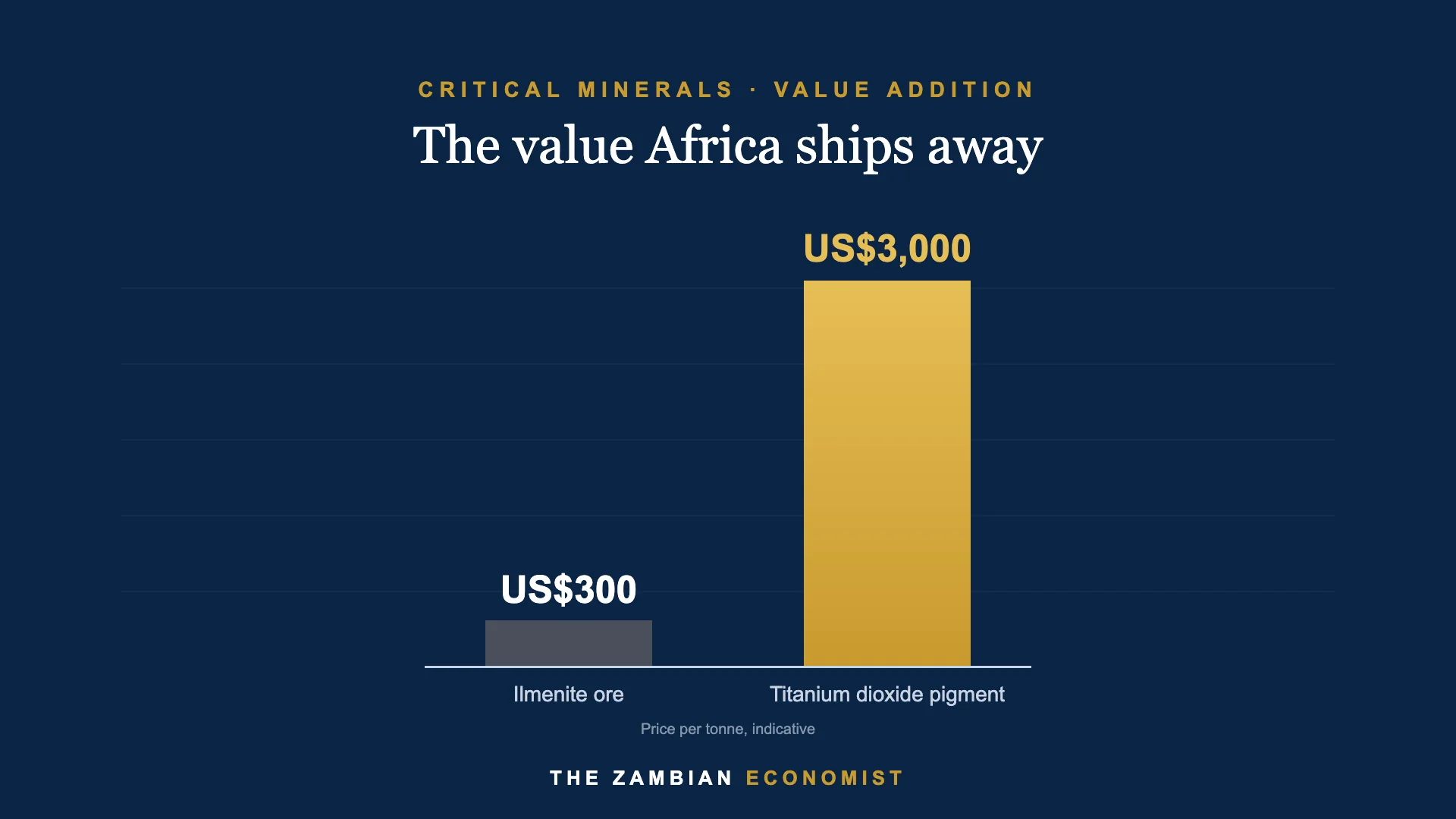
- Ilmenite leaves the continent for under US$300 a tonne. Titanium dioxide pigment made from it sells for more than US$3,000.
- Nyanza Light Metals’ US$850 million plant at Richards Bay began construction in June 2026 and is designed to make 80,000 tonnes of pigment a year, the first plant of its scale in Africa.
- The project became bankable through early support from South Africa’s trade ministry, development finance from AFC, Afreximbank, the IDC and a US$75 million AfDB loan, and customers signed before construction.
- For Zambia, where copper brings in 70 to 80 per cent of export earnings, the lesson is that beneficiation needs financed projects more than new strategy papers.
Africa will turn the critical minerals boom into industrial growth only if it processes far more of what it digs up, and the means to do so already exist. The Nyanza titanium project in South Africa shows how public development money, development finance institutions and customers signed in advance can convert a beneficiation policy into a plant with a construction date.
Gold that built someone else’s industry
The Witwatersrand Basin has produced roughly a quarter of all the gold ever mined. In the 1970s South Africa supplied almost two thirds of global output. That wealth supported the Bank of England, kept sterling as the world’s reserve currency and paid for imperial trade. Little of the industrial capability it financed was built in Africa.
The pattern has held since. African minerals feed prosperity elsewhere, and the continent keeps a small share of the return. The question now is whether the critical minerals boom will repeat it.
A second chance, on better terms
Clean energy, digital technology and artificial intelligence have raised demand for lithium, cobalt, graphite, manganese, copper, titanium and rare earths, many of which Africa holds in quantity. Governments and manufacturers want secure supply chains and processed material, not raw ore, and they want it for decades. That gives Africa bargaining power it has rarely had.
Most of the value still leaves before any factory is built. Estimates compiled from US Geological Survey, World Bank and industry data put local processing of Africa’s lithium, graphite, copper and gold for batteries and other uses at under 10 per cent.
How much of Africa’s minerals are processed at home?
| Mineral | Share processed in Africa | Note |
|---|---|---|
| Lithium, graphite, copper, gold (combined) | Under 10% | For batteries and other end uses |
| Graphite | 3% to 5% | Main material in battery anodes |
| Cobalt | About 20% | Reached under heavy geopolitical and ESG pressure |
| Titanium (ilmenite) | 0% to pigment or metal | South Africa holds the world’s second largest reserves |
Source: author’s compilation from USGS, World Bank and industry data.
The wider industrial picture is weak. The African Development Bank’s Africa Industrialisation Index, published in May 2026, puts Africa’s share of global manufacturing below 2 per cent and its share of manufactured exports at 1.4 per cent. Manufacturing value added per person is still lower than in 2014. South Africa, long the continent’s industrial leader, has slipped since 2010 and now ranks behind Morocco.
What does exporting raw ore cost Zambia?
Commodity dependence brings instability as well as lost value. Copper accounts for 10 to 15 per cent of Zambia’s GDP and 70 to 80 per cent of its export earnings. When prices fell and the pandemic struck in 2020, the economy contracted, and in November that year Zambia became the first African country to default on its debt during the pandemic.
Without local processing, downturns cut deeper and booms leave little behind. Processed products fetch higher prices and sell into steadier markets. They also need skilled workers and local suppliers, and those jobs and firms outlast any single price cycle.
Africa already has the blueprint
None of this is new thinking. The Africa Mining Vision, adopted by African Union heads of state in 2009, noted that “most of Africa’s minerals are exported as ores, concentrates or metals, without significant value-addition” and called for “down-stream linkages into mineral beneficiation and manufacturing”. Agenda 2063 envisages regional manufacturing hubs built on processed African minerals, with the African Commodities Strategy as its flagship programme for that purpose. The AU’s Green Minerals Strategy, published in 2025, commits to “value addition at source”.
Africa does not lack strategy. It lacks execution: too few bankable projects that turn policy into operating plants.
Nyanza: from policy to plant
South Africa holds the world’s second largest reserves of titanium minerals, yet none is processed into pigment or metal anywhere in Africa. The continent imports all the pigment and metal it uses. Ilmenite, the main raw material, is mined and shipped out for less than US$300 a tonne. Titanium dioxide pigment, used in paint, plastics, paper and ink, sells for more than US$3,000 a tonne.
| Product | Indicative price | Where it is made today |
|---|---|---|
| Ilmenite (mined ore) | Under US$300/t | Mined in Africa, exported |
| Titanium dioxide pigment | Over US$3,000/t | Imported into Africa |
A tonne of pigment is worth more than ten times a tonne of ore.
Nyanza Light Metals’ US$850 million plant in the Richards Bay Industrial Development Zone is designed to close that gap. It will produce 80,000 tonnes of pigment a year as Africa’s first large-scale titanium dioxide facility. The project is expected to create about 3,000 construction jobs and 850 permanent positions, with 45 per cent of permanent roles targeted for women, and to cut imports while adding export earnings.
How the project was made bankable
Financing came in phases. Support from South Africa’s Department of Trade, Industry and Competition (DTIC), alongside the sponsors’ own money, paid for feasibility studies and a testing centre that produced samples for customers to qualify. In 2021 the Africa Finance Corporation (AFC) and Afreximbank joined as co-developers, with AFC intending to take part in the principal investment. East China Engineering Science and Technology Corporation (ECEC), an established builder of titanium dioxide plants, was chosen as the engineering, procurement and construction contractor.
The sponsors then launched the Nyanza pigment brand using product from an ECEC-built plant already in operation. That secured customers before construction began, and protections written into the sales agreements gave lenders comfort.
| Date | Milestone |
|---|---|
| Early stage | DTIC and sponsor funding for feasibility studies and a customer-sample testing centre |
| July 2021 | AFC becomes co-development partner; Afreximbank joins as co-developer the same year |
| Pre-construction | ECEC appointed EPC contractor; Nyanza pigment brand launched and offtake secured |
| October 2025 | AfDB approves US$75 million in senior debt |
| June 2026 | Construction begins with piling and early civil works |
| By mid 2029 | First production expected, within 36 months of construction start |
Early public support did the most to lower risk. DTIC money paid for the development work that private lenders will not fund, and that opened the way for AFC, Afreximbank and the Industrial Development Corporation (IDC) to commit.
The plant is also meant to seed a second phase. Its by-products, trained workforce and customer base will support a battery-grade lithium iron phosphate project for energy storage, electric vehicles and data-centre power.
A Nyanza for every mineral
The approach can travel to other countries and other minerals. It depends on four things any resource-rich state can supply: early public investment to absorb development risk, special economic zones with working infrastructure and incentives, early involvement of development finance institutions, and regional markets big enough to buy the output.
The last of these is where Africa is weakest. Intra-African trade is only 14.4 per cent of the continent’s total, against 60 per cent in Asia, according to the AfDB. Full implementation of the African Continental Free Trade Area would give processors the scale that no single national market can.
What this means for Zambia
Zambia already refines most of its copper into cathode and anode before export, so it sits one rung above raw ore. Very little of that metal is turned into wire, cable, battery precursors or other fabricated goods at home. The government’s target of 3 million tonnes of copper a year by 2031, which depends on new mines such as Mingomba, would multiply export volumes. Without more processing it would also deepen the dependence that made the 2020 contraction so severe.
The tools named above are in place on paper. Zambia has multi-facility economic zones, including at Chambishi on the Copperbelt, and in 2022 it signed a cooperation agreement with the Democratic Republic of Congo to build a regional battery value chain. AFC is also leading development of the Zambia Lobito Railway, which would give Copperbelt producers a rail route to the Atlantic. What the Nyanza case adds is the sequence: state money for early studies, a development finance partner at the table from the start, a proven technology contractor, and customers signed before ground is broken. The test for Lusaka is whether one copper or battery-materials project under the Grow Zambia Agenda can be taken through those steps to financial close.
The benefits should stay where the minerals are
Africa needs projects like Nyanza in several regions and for several minerals. The Witwatersrand made other places rich. This time the gains should stay where the minerals come out of the ground.

Related coverage
WARNING! All rights reserved. This material and all other digital content on this website may not be reproduced, published, broadcast, rewritten, or redistributed, in whole or in part, without the prior express permission of The Zambian Economist. Where permission is granted, the content must be clearly credited to “The Zambian Economist,” with “www.zambianeconomist.com” prominently displayed.
WhatsApp: +260775574228 | Email: info@zambianeconomist.com
© 2026 The Zambian Economist.