Since January, public servants have taken home an extra K700 a month. With inflation at its lowest since 2018, the question is whether that money is buying more, or whether prices are quietly taking part of it back.
Key takeaways
- Public service employees have received a K700 increase in monthly basic salary since January 2026, and the daily meal allowance rose from K150 to K175.
- Annual inflation eased from 6.2 percent in August to 6.1 percent in September 2026, the lowest reading since February 2018.
- Food inflation fell from 6.0 to 5.8 percent. Non-food inflation held at 6.6 percent.
- Lower inflation does not mean lower prices. It means prices are rising more slowly, so the real value of the K700 still shrinks over time.
- Higher fuel prices from 1 October and a weaker kwacha are the next test of whether the gain holds.
A K700 increase in monthly basic salary looks straightforward on a payslip. Its economic effect is less straightforward.
Since January 2026, public service employees have received a K700 increase in their monthly basic salaries, while the daily meal allowance was raised from K150 to K175. The increase has arrived as Zambia’s inflation rate cools. Annual inflation fell from 6.2 percent in August to 6.1 percent in September 2026. Food inflation declined from 6 percent to 5.8 percent, while non-food inflation remained at 6.6 percent.
That raises a simple economic question. Is the K700 creating real additional purchasing power, or is part of it being absorbed by rising prices?
An economy can be read like a thermometer. When inflation accelerates, the temperature rises. When inflation slows, the temperature begins to cool. Zambia’s thermometer is showing a cooler reading. What that means for the K700 depends on what happens to incomes, prices and production.
Reading the thermometer
Lower inflation does not mean lower prices. It means prices are increasing at a slower rate.
For a public servant in Kitwe, the distinction matters. A household may still be paying more for food, transport and other necessities than it did a year ago, even though the rate at which prices are rising has slowed.
The K700 therefore increases nominal income, but its real value depends on what that money can buy. This is the difference between having more money and having more purchasing power.
| Indicator | August 2026 | September 2026 |
|---|---|---|
| Annual inflation | 6.2% | 6.1% |
| Food inflation | 6.0% | 5.8% |
| Non-food inflation | 6.6% | 6.6% |
| Monthly change in prices | 0.2% | 0.4% |
| Bank of Zambia target band | 6% to 8% | |
A rough illustration helps. At an annual inflation rate of 6.1 percent, K700 received a year from now buys about what K660 buys today. The payslip still shows K700. The shopping basket does not.
Where the K700 goes
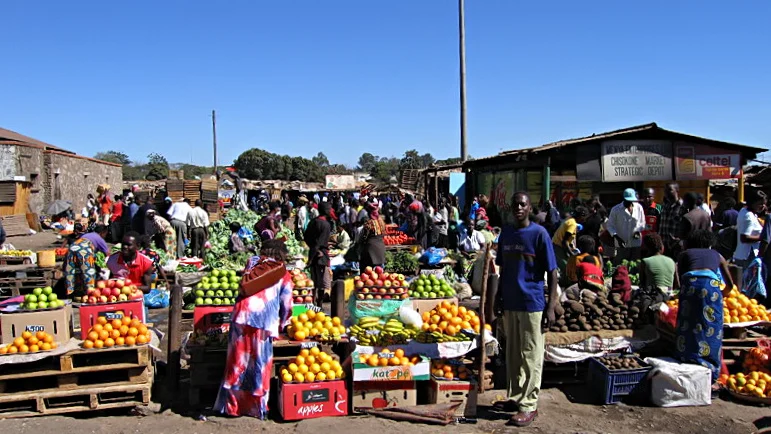
Consider a public servant using part of the extra income to buy groceries at Chisokone Market in Kitwe.
The money becomes income for a trader. The trader may use part of it to restock, creating revenue for a supplier. Transporters, producers and other businesses can also benefit as the money moves through the supply chain.
The salary increase can therefore strengthen demand beyond the household that receives it. For businesses, this creates an opportunity for higher sales. Whether that demand produces broader economic activity depends on the economy’s ability to respond.
The supply response
If businesses and producers can increase output as demand grows, additional spending is matched by additional goods and services.
If production remains limited, the same increase in demand can put pressure on available supplies and, eventually, on prices.
Food shows this relationship clearly. Food inflation stood at 5.8 percent in September, with price movements in mealie meal, maize grain, rice, vegetables, groundnuts and dried beans contributing to the overall figure. Our analysis of maize exports and food security risk sets out why the next harvest matters so much for these prices.
The K700 is therefore connected to conditions beyond the public service payroll. Its effect also depends on agricultural production, business capacity and the availability of goods.
What moves the thermometer?
Wages are only one part of the inflation equation.
The exchange rate influences the kwacha cost of imported fuel, machinery, raw materials and finished goods. Agricultural output affects food supply, while international energy and commodity prices feed into domestic costs. These forces can change the prices households face regardless of what happens to their incomes.
Two of them are already moving. Pump prices rose by about 24 percent from 1 October as excise duty returned, taking petrol to K31.46 and diesel to K33.27 a litre. We have explained how that fuel price shock can spread into food and transport costs. The kwacha has also weakened to around K19.9 per dollar, which raises the cost of imports. September’s monthly price rise of 0.4 percent was already the largest in five months.
The inflation rate reflects the interaction of demand, supply and production costs across the whole economy.
The real test
At 6.1 percent, inflation sits within the Bank of Zambia’s 6 to 8 percent target band. That is a very different environment from one in which prices are accelerating rapidly. It does not, on its own, settle whether the K700 has significantly improved household purchasing power.
If inflation stays contained while production and productivity rise, the extra income can translate into stronger real incomes and consumption. If price pressures return, part of the gain will be eroded.
There is also the cost to the Treasury. A pay rise across the public service adds to the wage bill at a time when the 2027 budget leaves only about K6.9 billion for other programmes, and the pressure on public sector pay structures is already building.
What it means
For business: traders, transporters and suppliers serving public service households have seen steadier demand this year. Sustaining it depends on keeping goods on the shelves at stable prices.
For investors: contained inflation within the central bank’s band supports a stable policy rate outlook. A fuel and currency driven rebound in prices would change that picture.
For public servants: the K700 is real money, but its value is set at the till, not on the payslip. Budgeting for higher transport and fuel related costs in the months ahead is prudent.
What to watch
- October inflation: the first reading that captures the higher pump prices.
- The kwacha: whether it steadies or continues to weaken against the dollar.
- Mealie meal prices: the clearest signal of food supply pressure for most households.
- The 2027 Budget: what it says about the public service wage bill and any further pay adjustments.
The K700 has changed the amount of money entering public servants’ pockets. Whether it has improved their economic position cannot be judged by the salary increase alone. The real measure is what that money can buy. Zambia’s economic thermometer is cooler. The question is whether it can stay that way while incomes rise, demand strengthens and production keeps pace.
More from our Inflation & Cost of Living and Macroeconomy & Policy coverage. Related: Zambia Raises Petrol to K31.46 and Diesel to K33.27 as Excise Duty Returns.
Follow The Zambian Economist on Facebook for the numbers behind the headlines. For weekly analysis, subscribe to The Ledger, or contact us to contribute.
Related: Zambia@62: A Self-Funded Independence Week for an Economy Told to Do More With Less.
WARNING! All rights reserved. This material and all other digital content on this website may not be reproduced, published, broadcast, rewritten, or redistributed, in whole or in part, without the prior express permission of The Zambian Economist. Where permission is granted, the content must be clearly credited to “The Zambian Economist,” with “www.zambianeconomist.com” prominently displayed.
WhatsApp: +260775574228 | Email: info@zambianeconomist.com
© 2026 The Zambian Economist.