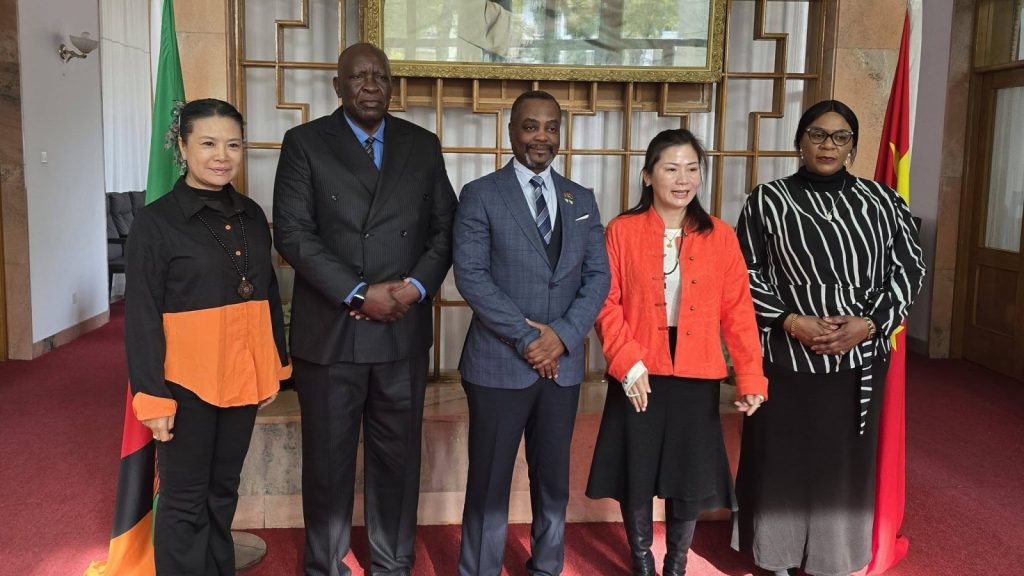

The Water Development and Sanitation Minister told French representatives that Zambia wants stronger partnerships to widen access to safe water and sanitation, and placed the effort under the Grow Zambia Agenda.
KEY TAKEAWAYS
- Minister of Water Development and Sanitation Elisha Matambo met representatives from France in Lusaka on Tuesday, 10 November 2026, to discuss cooperation in the water and sanitation sector.
- He said the Government is committed to working with France and other cooperating partners to improve access to safe, clean water and sanitation services.
- Matambo linked the sector to the Grow Zambia Agenda and said the country’s water and sanitation goals depend on strong partnerships and shared commitment.
- France’s development agency, AFD, lists water and sanitation among its three priority sectors in Zambia and has financed a €50 million water and sewerage programme on the Copperbelt.
- No new project, financing amount or agreement was announced after the meeting.
LUSAKA. Minister of Water Development and Sanitation Elisha Matambo has met representatives from France to discuss how the two countries can work together to expand water and sanitation services in Zambia.
At the meeting on Tuesday morning, 10 November 2026, the Minister said the Government is committed to strengthening international partnerships and working with cooperating partners to improve access to safe and clean water, and to sanitation services, for the people of Zambia.
What did Minister Matambo say?
Matambo said that under President Hakainde Hichilema, the Government remains committed to closer collaboration with France and other international partners to drive sustainable development in the water and sanitation sector.
He placed the effort within the Grow Zambia Agenda, which the Government presents as its programme to accelerate national development, improve service delivery and create opportunities for citizens. Meeting the country’s water and sanitation goals, he said, requires strong partnerships, shared commitment and collective action.
Matambo was among the ministers sworn in at State House in October, when he took charge of the water and sanitation portfolio in the President’s second term Cabinet.
What is France’s track record in Zambia’s water sector?
France works in Zambia mainly through the Agence Française de Développement (AFD), which opened its operations in the country in 2012. AFD reports about €250 million in commitments over ten years, with energy, water and sanitation, and transport as its three priority sectors.
Its largest water investment is a €50 million programme to rehabilitate and expand water and sewerage services on the Copperbelt, aimed at improving access to clean water and wastewater services for about 460,000 residents. France agreed the financing in 2014 for works in Mufulira, Chingola and Chililabombwe.
AFD has also provided technical support to Lusaka Water Supply and Sanitation Company, covering a diagnostic assessment of the utility and a feasibility study for a project that could be financed later. That earlier work means talks on the capital’s needs need not start from a blank page.
The meeting took place on the same day as the French Business Circle in Lusaka, where President Hichilema, in a speech read by Trade and Exports Minister Dr Caroline Kaunda Katotobwe, asked investors to turn partnerships into investment, exports and jobs.
Why water and sanitation matter to the Grow Zambia Agenda
Several Grow Zambia targets rest on water. The goal of 10 million tonnes of maize will depend in part on wider irrigation, and the target of 10,000 megawatts of electricity rests on a power system that still draws most of its supply from hydropower.
Water and sanitation also shape everyday productivity. Unreliable supply and poor sanitation carry costs through illness, lost working and school time, and the money households spend buying or fetching water. For towns and cities, utility capacity sets the pace at which new housing, factories and markets can be served.
The timing adds weight. With a strong El Niño expected to bring a drier than normal season to southern parts of the country, pressure on water sources for households, farms and power generation is likely to rise over the coming months.
What happens next?
The Ministry’s statement did not name the French representatives or announce a project, financing amount or timeline. The meeting is best read as an early step in setting priorities. Points to watch include:
- A project pipeline: whether the talks lead to specific projects, for example financing that builds on the earlier feasibility work with Lusaka Water Supply and Sanitation Company.
- Financing terms: whether any support comes as grants or concessional loans, and how new borrowing fits within Zambia’s debt sustainability commitments.
- Delivery on existing works: progress on the AFD-financed water and sewerage programme on the Copperbelt.
- Service outcomes: measurable gains in household connections, hours of supply and sewerage coverage, which will show whether partnerships translate into better services.
Related: Hichilema Calls for Value Addition to Make Zambia a Regional Manufacturing and Export Hub.
Related: Hichilema Urges Farmers to Plant Despite El Niño as Grow Zambia Tour Opens in Choma.
Related: Hichilema Swears In Newly Appointed Ministers at State House.
Related: Hichilema’s Second Term: What It Means for Zambia’s Economy, Markets and Diplomacy.
WARNING! All rights reserved. This material and all other digital content on this website may not be reproduced, published, broadcast, rewritten, or redistributed, in whole or in part, without the prior express permission of The Zambian Economist. Where permission is granted, the content must be clearly credited to “The Zambian Economist,” with “www.zambianeconomist.com” prominently displayed.
WhatsApp: +260775574228 | Email: info@zambianeconomist.com
© 2026 The Zambian Economist.