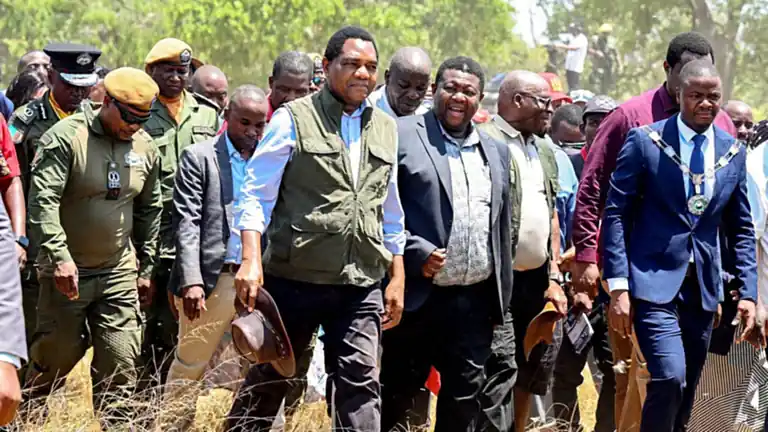
Opening a working visit to Southern Province, the President told farmers that leaving fields idle is not an option this season, and asked them to plant on the advice of agricultural and weather experts.
KEY TAKEAWAYS
- President Hakainde Hichilema arrived in Choma at the start of a working visit to Southern Province and urged farmers to plant this season despite El Niño.
- He asked farmers to follow agricultural and meteorological experts on what to plant and when, saying idle fields would put the national food supply at risk.
- He linked the visit to the Grow Zambia Agenda, which aims to build each province’s economy on its own resource base, and named agriculture as Southern Province’s strength.
- Regional outlooks point to drier than normal conditions in southern Zambia, and about 1.25 million people are projected to face acute food insecurity up to March 2027.
CHOMA. President Hakainde Hichilema has told Zambians, and farmers in particular, to plant this season even though El Niño has made the rains hard to predict.
Speaking on arrival in Choma at the start of a working visit to Southern Province, the President said leaving fields idle is not an option if the country is to secure its food supply. He asked farmers to take their cue from agricultural and meteorological experts on which crops to plant and when to put them in the ground.
He also said the government remains focused on growing the economy so that it generates treasury income and opens up business and job opportunities under the Grow Zambia Agenda.
What did President Hichilema say in Choma?
The President carried two messages. The first was for farmers: plant, but plant with guidance. Rather than wait to see how the season unfolds, he wants farmers to act on the advice of extension officers and weather forecasters, choosing crops and planting dates that suit a season expected to be difficult.
The second concerned the wider economy. A central idea of the Grow Zambia Agenda, he said, is that each province should build its economy around its own resource endowments. In Southern Province, that means agriculture.
The appeal builds on a warning the President gave in early October, when he told traditional leaders in Chief Choongo’s area of Southern Province to make sure households kept enough maize for their own needs, because an El Niño drought was coming. Farmers there were encouraged to move into wheat and soya beans, two crops the government has marked for higher output.
Why Southern Province matters to the Grow Zambia Agenda
Southern Province is one of Zambia’s main maize growing and cattle rearing areas, and its produce reaches markets well beyond the province. It is also among the areas most exposed to dry spells.
The country has recent experience of what El Niño can do. In the 2023/24 season, drought destroyed about 1 million of the 2.2 million hectares planted to maize and affected 84 of Zambia’s 116 districts, leading the President to declare a national disaster in February 2024. Southern Province was among the hardest hit areas.
Under Grow Zambia, the government has set national targets of 10 million tonnes of maize, 3 million tonnes of soya beans and 1 million tonnes of wheat. How Southern Province fares in a dry year will weigh on whether those numbers move at all in the near term.
What does the forecast say for the 2026/27 season?
The national seasonal rainfall forecast for 2026/27, presented by Secretary to the Cabinet Patrick Kangwa in September, identified El Niño as the main climate factor to monitor this season. The regional SARCOF-33 outlook rates southern Zambia as likely to be drier than normal, and the World Meteorological Organization has put the probability of El Niño extending into early 2027 above 80 per cent.
FEWS NET, the famine early warning network, expects below average rainfall and a delayed start to the rains across much of the country. The food security picture is already tight. The Integrated Food Security Phase Classification analysis projects that about 1.25 million people will face Crisis or worse levels of acute food insecurity between October 2026 and March 2027, and the government has disbursed K31.7 million for relief food in prioritised districts.
Why “plant anyway” makes economic sense
An unplanted field yields nothing whatever the weather. A planted one at least has a chance. Seasonal forecasts deal in probabilities: drier than normal does not mean no rain, and how rainfall is spread across the season often matters as much as the total.
The President’s emphasis on expert advice is where the argument rests. Early maturing and drought tolerant varieties, conservation farming that holds soil moisture, and a mix of crops rather than reliance on maize alone all improve the odds of harvesting something in a poor season. Agricultural extension officers and the Zambia Meteorological Department, which updates its bulletins as the season progresses, are meant to guide those choices.
Inputs are part of the equation. By 22 October, 670,371 farmers had redeemed inputs under the Farmer Input Support Programme, about 65 per cent of the 1,024,434 targeted for the season, and the government said about 600,000 farmers had received training in climate smart agriculture.
The risk does not fall evenly. Commercial farmers with irrigation can hedge against poor rains. Smallholders on rain fed land carry most of the exposure: they spend on seed, fertiliser and labour up front, and bear the loss if the rains fail. The call to plant will carry more weight if it is matched by inputs that arrive on time, reliable weather advisories at district level, and markets for crops such as sorghum, cassava and soya beans that cope better with dry conditions.
What to watch
- Onset of the rains: whether planting rains arrive on time across Southern Province over the coming weeks, and whether the Zambia Meteorological Department revises its outlook.
- Input delivery: how quickly the remaining FISP beneficiaries redeem their inputs.
- Planted area: the next Crop Forecast Survey will show whether farmers heeded the call to plant, and what they chose to grow.
- Food prices: maize grain and mealie meal prices through the lean season to March.
- The rest of the visit: any further announcements on agriculture, water harvesting or irrigation during the President’s time in Southern Province.
Related: 670,371 Farmers Redeem FISP Inputs as Zambia Prepares for El Niño.
Related: Zambia disburses K31.7 million for food relief ahead of El Niño.
Related: Super El Nino 2026/2027: Why a Warm Patch in the Pacific Threatens Zambia’s Food, Power and Budget.
Related: Hichilema Calls for Value Addition to Make Zambia a Regional Manufacturing and Export Hub.
Related: Can the Grow Zambia Agenda Reduce Zambia’s Economic Dependence on Copper?
Related: Matambo Meets French Delegation to Deepen Water and Sanitation Cooperation.
WARNING! All rights reserved. This material and all other digital content on this website may not be reproduced, published, broadcast, rewritten, or redistributed, in whole or in part, without the prior express permission of The Zambian Economist. Where permission is granted, the content must be clearly credited to “The Zambian Economist,” with “www.zambianeconomist.com” prominently displayed.
WhatsApp: +260775574228 | Email: info@zambianeconomist.com
© 2026 The Zambian Economist.