The 2025 audit records K3.56 billion in unpaid health obligations, K626.64 million in uncollected mining penalties and weaknesses in farm-input support. The economic cost reaches suppliers, patients and farmers.
Key takeaways
- The Auditor General’s report on the 2025 accounts contains 27 audit-finding paragraphs that remained unresolved at 30 September 2026.
- The Ministry of Health owed K3.56 billion at the end of 2025. Separately, K626.64 million in mining penalty fees remained uncollected at 31 August 2026.
- Auditors found farm-input redemptions by inactive or unapproved beneficiaries, and education payroll entries that stations could not account for.
- The national financial statements received a favourable audit opinion. That does not mean every transaction or public programme complied with the rules.
- The full report is available to download below. The figures describe different problems and must not be added together as a single amount stolen.
Zambia’s newly released Auditor General’s report on the 2025 accounts shows how unpaid government bills and weak controls can affect the delivery of public services even when the national financial statements are fairly presented.
The report, signed by Acting Auditor General Patricia Malaila, records K3,564,361,363 in outstanding Ministry of Health obligations at 31 December 2025. It separately identifies K626,640,000 in mining penalty fees that had not been collected by 31 August 2026.
These are different accounting problems. One is money government owes; the other is revenue assessed but not collected. For a supplier waiting for payment or a hospital managing scarce resources, the distinction does not make the consequences less real. It does tell citizens what remedy to demand.
What does the 2025 Auditor General’s report cover?
The report examines ministries, provinces, agencies and other publicly financed institutions for the financial year ended 31 December 2025. Its executive summary says it contains 27 paragraphs of findings that could not be resolved during the audit, with corrective action still outstanding at 30 September 2026.
The office says controlling officers had opportunities to explain findings and provide supporting documents. Its methodology included management letters, verification and draft audit paragraphs, which could be amended where valid evidence changed the facts.
This is not the separate Constituency Development Fund audit. The report states that CDF audits will be reported separately. Our CDF audit explainer sets out how that process works.
A favourable opinion is not an all-clear on spending
On printed page 6, the Auditor General concludes that the national financial statements were fairly presented in all material respects under the applicable cash-basis accounting framework.
That opinion concerns the financial statements. The same report documents failures in revenue collection, procurement, payroll records and programme eligibility. Readers should distinguish reliable presentation of the accounts from compliance in the underlying operations.
For a guide to terms such as irregular payments, unsupported expenditure and misappropriation, see what an Auditor General’s report actually means.
Health arrears put the pressure on suppliers
The Health Ministry’s K3.56 billion in outstanding obligations comprised K1,998,059,122 in other personal emoluments and K1,566,302,241 owed to suppliers of goods and services. Some supplier invoices dated back to 2014, according to printed page 120.
These are accumulated obligations at the end of 2025, not a finding that K3.56 billion was stolen during that year.
For businesses, an unpaid government invoice ties up working capital. A supplier still has wages, transport costs and financing charges to meet while waiting for the Treasury. Prolonged delays can discourage smaller firms from competing for public contracts or lead bidders to price payment risk into future offers. These are economic risks arising from arrears, rather than effects measured by this audit.
The report also gives a practical example of infrastructure pressure. Mbala General Hospital operated without an oxygen plant and spent K853,291 procuring and transporting oxygen from Kitwe and Kasama during the period reviewed. The finding connects a missing facility with a recurring operating cost.
Related health-service reporting: Chilengi’s Livingstone hospital spot check: medicine availability and the follow-up questions for patients.
Mining revenue needs collection as well as assessment
The Ministry of Mines and Minerals Development had not collected K626.64 million in penalty fees by 31 August 2026, the report says. The penalties involved 5,222 clients and breaches including non-submission of reports, pegging and area-charge requirements.
Separately, K30,479,393 in annual area charges from mining-right and mineral-processing licence holders remained outstanding at that date. These findings appear on printed pages 60–61.
The fiscal issue is collection and enforcement. An assessed charge does not finance a public service until it is paid. Nor should an outstanding penalty automatically be treated as cash that could be recovered immediately: the report does not establish a collection timetable or the recoverability of every balance.
As Zambia seeks more investment and domestic benefit from mining, administrative follow-through deserves attention alongside production targets. Our analysis of mining, local businesses and value addition considers the wider economic test.
Farm-input support: the beneficiary register matters
The audit found that 2,128 inactive farmers were loaded with K17,761,800 in redeemable inputs, of which K17,247,842 was subsequently redeemed. Management said the farmers who redeemed would be required to repay. The report says repayment had not occurred by 31 August 2026.
Another finding records 2,339 farmers whose details could not be traced on the authorised existing National Farmer Register on ZIAMIS redeeming K19,647,400 in inputs.
The report also identifies 4,213 beneficiaries across ten provinces who redeemed K34,923,488 under FISP while benefiting from other government programmes, contrary to the applicable guidelines.
These categories should be examined separately; this article does not assume they are mutually exclusive or add them into a loss total. For eligible farmers, the policy question is whether beneficiary checks can prevent irregular redemptions while allowing legitimate support to arrive on time. The detailed findings are on printed pages 169–174.
Payroll checks must reach the duty station
In education, 24 stations could not account for 125 officers who drew K1,228,635 in salaries. The report says the officers were neither on staff returns nor known to management at the respective stations and remained unaccounted for at 31 August 2026.
This is the audit’s description of unresolved payroll records. It is not, by itself, a criminal finding against each officer. The remedy begins with reconciling payroll entries, staff returns and actual placements, followed by recovery or disciplinary action where the evidence warrants it.
What should happen after publication?
The Auditor General recommends stronger revenue tracking, procurement oversight and regular reconciliation of payroll with staff records. The recommendations also call for timely removal of separated officers from payroll and tighter contract monitoring.
For Parliament and the public, a useful next step would be a dated follow-up record showing the finding, responsible institution, response, amount recovered or settled, and evidence that the problem has been corrected. Recovery of uncollected revenue should be reported separately from settlement of government debts.
Businesses considering public contracts should check payment terms and maintain complete delivery and procurement records. Investors should look for evidence of enforcement and resolution. Citizens can use the report to ask specific questions about the service or programme affecting their community.
Publication makes the problems visible. The next test is whether the relevant institutions can demonstrate that bills are being settled, amounts due are being collected and the same control failures are being prevented.
New citizens’ guide: Read our introduction to Lubinda Sinyani’s independent, 26-page guide and download “Where Did Our Money Go?”
Read the source report
Read or download the complete 2025 Auditor General’s report. This article draws on the executive summary, printed pages 2–3 and 6, mining findings on pages 60–61, health findings on pages 107 and 120, education findings on page 139, FISP findings on pages 169–174, and recommendations on pages 233–236. PDF viewer page numbers differ from the printed numbering.
Reporting note: findings and management responses above are attributed to the report and retain its stated cut-off dates. The article does not establish whether individual matters have been resolved since those dates. The official report is reproduced as a source document; its authorship remains with the Office of the Auditor General.
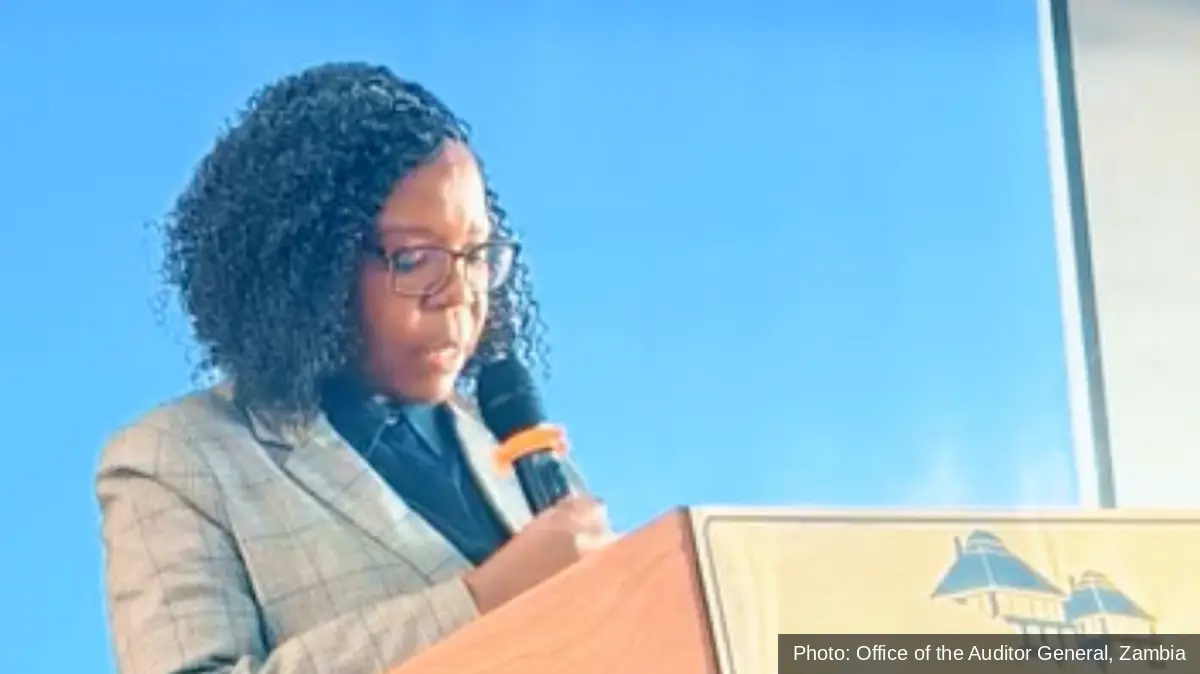
File photograph: Acting Auditor General Patricia Malaila at an earlier OAG budget preparation meeting. Credit: Office of the Auditor General, Zambia.
Explore our Auditor General Explained hub and coverage of the office’s budget priorities. Subscribe to The Ledger for weekly analysis, browse events, or read about us and contact the team.
WARNING! All rights reserved. This material and all other digital content on this website may not be reproduced, published, broadcast, rewritten, or redistributed, in whole or in part, without the prior express permission of The Zambian Economist. Where permission is granted, the content must be clearly credited to “The Zambian Economist,” with “www.zambianeconomist.com” prominently displayed.
WhatsApp: +260775574228 | Email: info@zambianeconomist.com
© 2026 The Zambian Economist.
Work With The Zambian Economist
Related: Kawina Takes the Chair at Public Accounts Committee, Succeeding Mwambazi