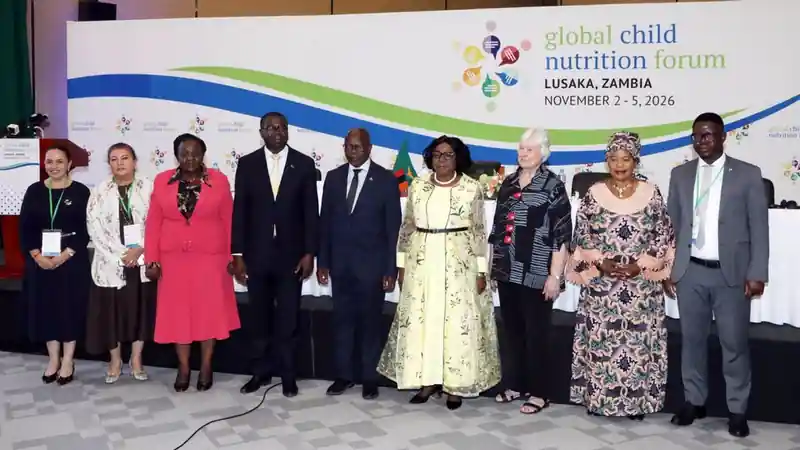
Opening the 2026 Global Child Nutrition Forum, the Vice President said Zambia’s school meals now reach more than 5.6 million learners in every district. Keeping that going will take steadier financing, sturdier supply chains and better school facilities.
KEY TAKEAWAYS
- Vice President Mutale Nalumango opened the 2026 Global Child Nutrition Forum in Lusaka on 2 November, representing President Hakainde Hichilema. The forum runs until 5 November.
- She said Zambia’s Home-Grown School Meals Programme now benefits more than 5.6 million learners across all 116 districts.
- The programme buys food locally, which she said creates markets for farmers and supports rural economies.
- She named the main obstacles as climate shocks, inadequate school infrastructure, limited clean cooking technology and persistent malnutrition.
- She called for more investment in research, innovation and sustainable financing for school meals.
Vice President Mutale Nalumango has called for stronger global partnerships and sustainable financing to keep school meal programmes running, as Lusaka hosts the 2026 Global Child Nutrition Forum. Opening the forum on 2 November on behalf of President Hakainde Hichilema, she told delegates that countries must turn commitments into practical action that guarantees learners a nutritious meal.
The forum, organised by the Global Child Nutrition Foundation with the Government of Zambia, runs until 5 November under the theme “From Vision to Action: Achieving Ambitious School Meal Programme Objectives”. It follows the 2024 edition in Osaka, Japan.
Why school meals are an economic policy
Nalumango described school feeding as an investment in education, health, agriculture and national development. The education case is the most direct. She linked meals to concentration, attendance and learning outcomes, and said the Free Education Policy has pushed enrolment up, which makes support for learners’ wellbeing more urgent. Education Minister Douglas Syakalima has previously said school feeding attracted about 2 million additional learners, especially the most vulnerable.
The agricultural case is where the “home-grown” label matters. Food bought from local producers turns a social programme into a steady buyer for smallholders. Zambia has an estimated 1.6 million smallholder farmers, and direct purchasing through farmer cooperatives has been formalised in ten districts since 2021, according to the Global Child Nutrition Foundation. Each district that shifts its procurement to local cooperatives keeps more of the programme’s spending in rural economies.
How far the programme has grown
| Indicator | Figure |
|---|---|
| Learners reached (2026) | More than 5.6 million |
| Districts covered | All 116 |
| Earlier reach | 4.6 million learners in 106 districts and 8,193 schools |
| Government ownership | Since 2019, under the Ministry of Education |
The financing question
Coverage has grown faster than funding has settled. In 2022 the programme’s budget was about US$8.7 million, of which government funded 27% and development partners the rest, according to the Global Child Nutrition Foundation. A programme that depends mostly on donors is exposed whenever aid budgets shift, which is why the Vice President’s emphasis on sustainable financing matters.
The challenges she listed point to where money is needed. Drought and other climate shocks hit the same farmers who supply the meals. School infrastructure is often inadequate, and the Vice President acknowledged that access to clean cooking technology is still limited. The 2027 National Budget, due on Friday, 6 November, will show how much government is prepared to carry from its own resources.
What to watch
- The 2027 allocation for school feeding, and the share funded by government rather than partners.
- Local procurement. Whether direct buying from cooperatives spreads beyond the first ten districts.
- Forum commitments. Any financing, research or technical partnerships announced before the forum closes on 5 November.
Related coverage
- 670,371 Farmers Redeem FISP Inputs as Zambia Prepares for El Niño
- Beyond Economic Growth: What Should Zambia’s Development Actually Deliver for Ordinary Citizens?
- Libala to the Value Chain: How Ordinary Zambians Can Plug Into the Grow Zambia Agenda
- Budget 2027: A Bigger Envelope With Only K6.9 Billion of Room
Related: Feeding a Child Is an Economic Decision: Why Zambia Should Budget for Nutrition Like Infrastructure
WARNING! All rights reserved. This material and all other digital content on this website may not be reproduced, published, broadcast, rewritten, or redistributed, in whole or in part, without the prior express permission of The Zambian Economist. Where permission is granted, the content must be clearly credited to “The Zambian Economist,” with “www.zambianeconomist.com” prominently displayed.
WhatsApp: +260775574228 | Email: info@zambianeconomist.com
© 2026 The Zambian Economist.