The Commission says vacant seats were redistributed under electoral law after a qualifying party failed to submit its list within the prescribed period.
Key takeaways
- ECZ says its redistribution of vacant proportional representation seats followed the law, rejecting allegations of political favouritism.
- Section 36C(1) sets a seven-day period after seat distribution for submitting a party list.
- Section 36C(9) provides for redistribution when a party fails to submit its list within the prescribed period.
- ECZ says only two of the 13 parties that contested the August election qualified for PR seats.
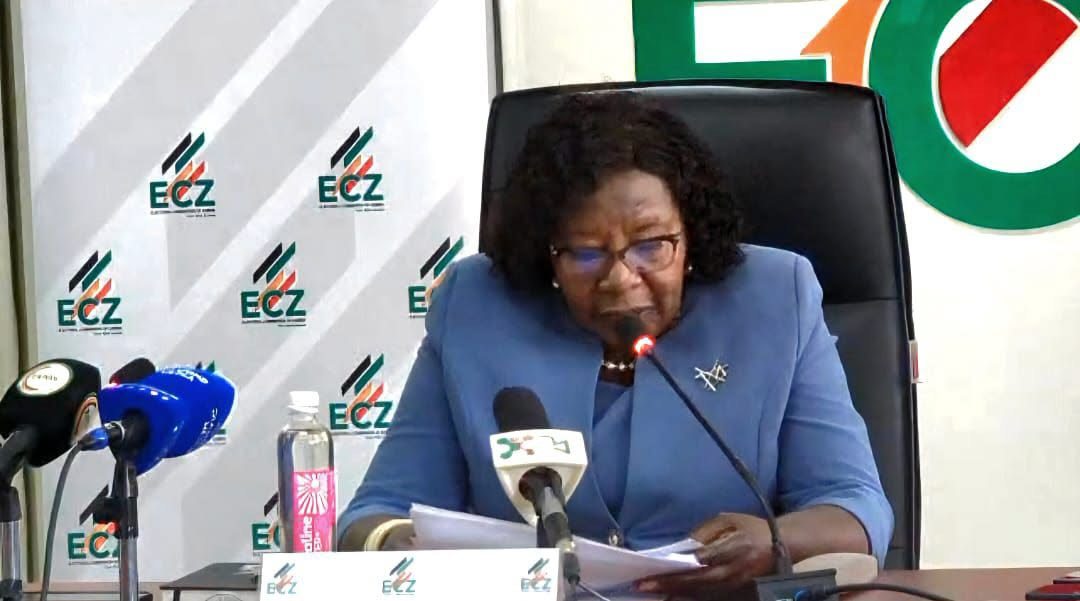
The Electoral Commission of Zambia has defended its redistribution of vacant proportional representation seats, saying the decision followed legal requirements after a qualifying political party failed to submit its party list on time.
ECZ Chairperson Mwangala Zaloumis, SC, gave the explanation at a media briefing in Lusaka, according to the briefing summary supplied to The Zambian Economist. She rejected allegations of collusion, manipulation and political favouritism.
The Commission’s position is that the law required it to redistribute the vacant seats. Establishing how that requirement applied in this case also depends on the allocation notices and the record of party-list submissions.
What does the seven-day rule say?
Sections 36B and 36C were introduced into the Electoral Process Act by the Electoral Process (Amendment) Act No. 12 of 2026. The enacted text is available through ZambiaLII’s copy of the Act.
Section 36C(1) requires a party list within seven days after seats are distributed under Section 36B. The statutory wording refers to distribution of seats. ECZ’s account of when parties were notified is a separate part of the chronology.
Section 36C(9) directs the Commission to redistribute a vacant seat to a qualifying party, using the Section 36B formula, when a party does not submit its list within the specified period. Section 36C(10) excludes the non-submitting party’s presidential votes from that distribution.
Those provisions establish a legal mechanism for redistribution. They do not, on their own, verify every procedural step taken in a particular allocation.
ECZ’s account of the notifications
Zaloumis said the Commission notified qualifying parties of their allocations, submission deadlines and nomination requirements on 7 September 2026. Further guidance was provided at a meeting on 9 September, according to the supplied summary.
| Date | Action reported by ECZ |
|---|---|
| 13 August 2026 | General election contested by 13 political parties |
| 7 September 2026 | Qualifying parties notified of allocations, deadlines and nomination requirements |
| 9 September 2026 | Further guidance provided at a meeting |
ECZ said only two of the 13 parties qualified for PR seats. The supplied summary does not provide a complete allocation table or state the number of vacant seats redistributed. It also does not include the underlying notices or submission records.
Why the Commission says it had no discretion
Zaloumis said ECZ was bound by the law and had no authority to award seats as political favours. The Commission’s defence rests on the submission deadline and the redistribution provisions, rather than a discretionary choice of beneficiary.
She acknowledged public interest in Zambia’s newly introduced mixed member proportional representation system and reaffirmed the Commission’s openness to legitimate scrutiny. Political parties and the public were urged to base commentary on facts, applicable laws and institutional processes.
What would allow the public to check the decision?
The allocation table, dated notices and submission record would allow readers to follow the process from the original distribution to the vacant seats and their reassignment. The calculation used for redistribution would show how the statutory formula was applied.
Publishing those records would make the decision easier to assess. The existence of a redistribution rule and the accuracy of its application are related questions, but each requires its own evidence.
The supplied material contains ECZ’s explanation and rejection of the allegations. It does not include a response from the affected party or a judicial determination of the dispute.
Why this matters beyond party politics
Seat allocation affects representation in the institutions that scrutinise public spending and make policy. For citizens and businesses, confidence in that process depends on clear rules and a record that can be checked.
The immediate issue is whether the submission requirements and redistribution formula were applied correctly. ECZ has set out its legal position; the supporting records remain central to public scrutiny.
Sources: Supplied summary of the ECZ media briefing; Electoral Process (Amendment) Act No. 12 of 2026, particularly Sections 36B and 36C. Meeting dates and party qualification figures are attributed to ECZ’s account.
Related coverage
Read The ECZ Says No Seats Were Stolen. Here Is the Arithmetic Behind the Argument. Explore our Election 2026 Economics hub and Leadership & Governance reporting.
WARNING! All rights reserved. This material and all other digital content on this website may not be reproduced, published, broadcast, rewritten, or redistributed, in whole or in part, without the prior express permission of The Zambian Economist. Where permission is granted, the content must be clearly credited to “The Zambian Economist,” with “www.zambianeconomist.com” prominently displayed.
WhatsApp: +260775574228 | Email: info@zambianeconomist.com© 2026 The Zambian Economist.