By The Zambian Economist Analyst | Washington DC | 12 November 2026
- The United States has formally backed President Hakainde Hichilema’s Grow Zambia Agenda, including the target of raising copper output to three million metric tonnes a year.
- Jason Grubb, Director of the Office of Southern African Affairs at the State Department, said Washington now prefers trade over aid and wants partnerships that produce measurable results.
- Ambassador Chibamba Kanyama told American investors that regulatory reforms and set production targets in agriculture, mining, energy and tourism are making Zambia easier to invest in.
- American firms have been invited to the second Invest Zambia International Conference in December 2026.
- Zambia produced roughly 820,000 tonnes of copper in 2024, which means the three-million-tonne target requires output to nearly quadruple.
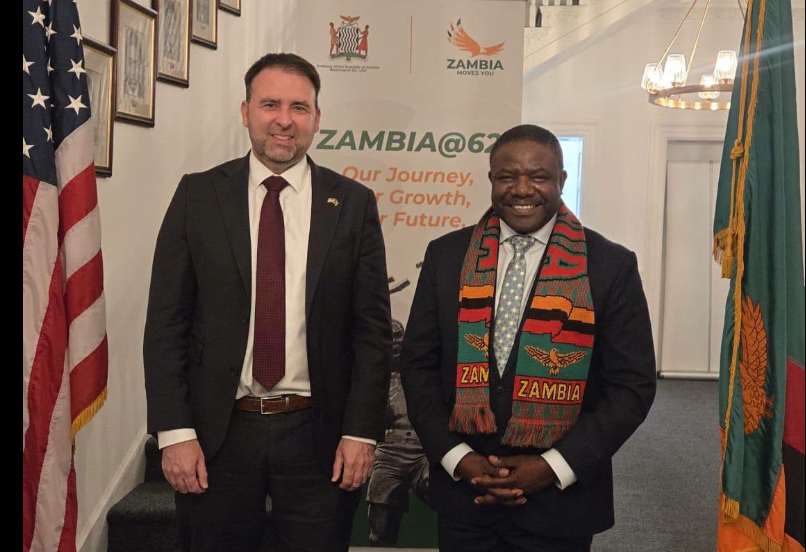
The United States has committed to supporting Zambia’s bid to triple copper production to three million metric tonnes a year, in what both governments are framing as a shift from donor-recipient relations to commercial partnership. Jason Grubb, Director of the Office of Southern African Affairs at the US Department of State, announced the position during Zambia’s 62nd Independence Anniversary reception at the Zambian Embassy in Washington DC, saying Washington now values partnerships “that deliver tangible results” and is deliberately prioritising a move from aid to trade.
Grubb said higher copper output would create jobs and improve mining communities, and that the United States stands ready to support Zambia’s wider economic programme under the Grow Zambia Agenda, President Hakainde Hichilema’s plan to lift growth through agriculture, mining, energy and tourism. He also commended Zambia’s record of peace under the One Zambia, One Nation motto, describing the two countries’ history as one worth honouring.
Why the three-million-tonne target is the hard part
The pledge lands on a target that is easier to announce than to reach. Zambia produced about 820,000 tonnes of copper in 2024, according to the Ministry of Mines and Minerals Development. Reaching three million tonnes means nearly quadrupling output, a level the country has never come close to; production peaked at around 850,000 tonnes in the early 1970s before decades of decline under state ownership.
The Hichilema administration has staked the turnaround on new mines and expansions, several of them with American money behind them. KoBold Metals, the California-based explorer funded by Bill Gates’s Breakthrough Energy Ventures, is developing the Mingomba copper project in Chililabombwe and announced a US$1 billion financing in June 2025 to accelerate it. Other firms expanding in the Copperbelt and North-Western Province include First Quantum, Barrick Lumwana and Mopani, the latter now under Zambian ownership after the 2023 acquisition from Glencore.
Whether the US government’s endorsement adds concrete capital, or remains diplomatic encouragement, will show in project financing, offtake agreements and the pace of the US-funded Lobito Corridor rail rehabilitation, which is designed partly to move Zambian and Congolese copper to Atlantic ports.
Kanyama courts American investors
Zambia’s Ambassador to the United States, Chibamba Kanyama, told the reception the Grow Zambia Agenda is built to stimulate job creation and raise local production across agriculture, mining, energy and tourism. He said regulatory reforms and clear production targets are positioning Zambia as a competitive destination for international trade and American investment, and invited US businesses to the second Invest Zambia International Conference scheduled for December this year.
“Zambia’s economic diplomacy is increasingly focused on building mutually beneficial partnerships,” Kanyama said, in remarks that mirror the aid-to-trade language coming from the State Department. The ambassador, an economist and former corporate affairs executive before his posting to Washington, has made investment promotion the core of the embassy’s programme.
What it means for business, investors and policy
For business: Suppliers, contractors and service firms in the Copperbelt should watch the December conference closely. Every large-scale mine expansion drags a supply chain behind it, from drilling and catering to haulage and power. Local content rules will decide how much of that spending stays in Zambia, a question examined in Growing Zambians, Not Just Zambia: Putting Citizens at the Centre of the Grow Zambia Agenda.
For investors: Explicit US political backing reduces country-risk perception for American capital weighing Zambian mining exposure. Combined with the debt restructuring completed in 2024 and a stable kwacha in recent months, the environment for mining finance is more favourable than at any point in the past decade, though questions about copper dependence itself remain, as we explored in Can the Grow Zambia Agenda Reduce Zambia’s Economic Dependence on Copper?
For policy: The aid-to-trade framing means Zambia should expect fewer grants and more commercial instruments, export credit, trade finance and equity. That puts the burden on ZESCO’s power availability, the mines’ electricity deficit and licensing turnaround times to actually deliver the production numbers politicians keep quoting, a pressure point visible in Finance Minister Situmbeko Musokotwane’s push for KoBold to fast-track Mingomba.
Diaspora asked to pull its weight
Ndemena Chitumbo, president of the Association of Zambians in DC, Maryland and Virginia, urged Zambians abroad to stay connected to home and back the Grow Zambia Agenda through investment, business partnerships, professional networks and knowledge exchange. Remittances to Zambia already run well above US$100 million a year according to World Bank data, and the government is increasingly treating the diaspora as a source of capital rather than merely sentiment.
The statements were issued by Charles Tembo, Press Secretary for Press and Public Relations at the Zambian Embassy in Washington DC.
Readers wanting the wider picture can follow our coverage of the Grow Zambia national tour, explore opportunities in our Business Directory, or submit an article on Zambia’s investment climate.
Main image: US State Department official Jason Grubb with Zambia’s Ambassador to the United States Chibamba Kanyama at the Zambia@62 Independence Anniversary reception in Washington DC. Photo: Zambian Embassy in Washington DC.
WARNING! All rights reserved. This material and all other digital content on this website may not be reproduced, published, broadcast, rewritten, or redistributed, in whole or in part, without the prior express permission of The Zambian Economist. Where permission is granted, the content must be clearly credited to “The Zambian Economist,” with “www.zambianeconomist.com” prominently displayed.
WhatsApp: +260775574228 | Email: info@zambianeconomist.com © 2026 The Zambian Economist.
Work With The Zambian Economist: Advertise With Us | List With Us | Submit an Article
Related: The talent pipeline the agenda depends on is the subject of Zamtel and ZRA Putting K100,000 Behind Zambia’s Next Generation of Problem-Solvers.
Related: Luanshya Copper Mine Revival: 100,000 Tonnes and 3,000 Jobs in Sight