
The Africa Finance Corporation briefed President Hichilema as contract talks for the Zambia Lobito Railway begin. About US$1.3 billion has been pledged towards a line that could cost up to US$5 billion.
KEY TAKEAWAYS
- President Hakainde Hichilema received an Africa Finance Corporation (AFC) delegation led by its President and Chief Executive, Samaila Zubairu, for an update on the Zambia Lobito Railway.
- The briefing covered progress in selecting the engineering, procurement and construction (EPC) contractor. AFC named preferred bidders for the Zambian and Angolan sections last week.
- The planned 830 km greenfield line would link the Copperbelt and North-Western Province to Angola’s Benguela railway and the Atlantic port of Lobito.
- Lenders committed about US$1.32 billion in April. Total cost has been reported at up to US$5 billion, with financial close targeted for late 2027 and completion in 2030.
- The President described the railway as a pillar of the Grow Zambia Agenda that will move freight from road to rail and cut transport costs.
President Hakainde Hichilema has received a delegation from the Africa Finance Corporation, led by its President and Chief Executive Officer Samaila Zubairu, for an update on the Zambia Lobito Railway. In a statement on 2 November, the President said the briefing included progress on selecting the project’s engineering, procurement and construction contractor.
He called the project a pillar of the Grow Zambia Agenda, expected to drive investment, value addition, jobs and regional trade across COMESA, SADC and the East African Community. “Africa trades less within itself than any other continent. The Lobito Corridor will help change this,” he said, pointing to stronger links with Angola and the Democratic Republic of Congo.
Where the contractor search stands
AFC, the lead sponsor and developer, announced its preferred EPC bidders in late October. A consortium of Webuild, Mota-Engil and IC İçtaş was selected for the Zambian section, and Mota-Engil with Odebrecht for the Angolan section. Contract negotiations start this month, and AFC aims to conclude the EPC agreements within eight to twelve weeks, subject to technical, commercial and legal terms.
| Milestone | Date or status |
|---|---|
| Memorandum of understanding | October 2023 |
| Concession agreements | 2024 |
| Intergovernmental agreements | 2025 |
| Financing pledges (AFC, AfDB, Italy) | About US$1.32 billion, April 2026 |
| Preferred EPC bidders named | Late October 2026 |
| EPC agreements | Targeted within 8 to 12 weeks of talks starting in November |
| Financial close | Targeted for the fourth quarter of 2027 |
| Completion | Targeted for 2030 |
The money and the cargo
In April, AFC and the African Development Bank each committed US$500 million and Italy US$320 million. Reuters reported that the line could cost up to US$5 billion, so most of the funding is still to be raised. AFC has said it will raise debt and equity ahead of financial close in late 2027, and construction is meant to start once the money is in place.
Lenders will look hard at cargo. Mining Weekly, citing Bloomberg, reported in April that AFC had signed initial agreements for about 1 million tonnes of freight, roughly half the minimum it needs for the line to be viable. Firm commitments from Copperbelt and North-Western Province miners are what will turn pledges into a financed project. That links the railway to the push for faster copper production: more tonnes from new mines mean more freight for the line.
Why road to rail matters
Much of Zambia’s copper now leaves by truck to ports in Tanzania, South Africa and Namibia. Heavy trucks wear out roads that government must then repair, and long road journeys add to the cost of every tonne exported. A rail route west to the Atlantic would give exporters a shorter path to European and American markets and a second option alongside the eastern and southern corridors. The Angolan side has already moved: in December 2025 the US International Development Finance Corporation signed a US$553 million loan to upgrade the existing Lobito Atlantic Railway.
The President said the Lobito line, like government’s other railway projects, will shift freight from road to rail. Zambia is also working on its existing network, including the Japanese-funded support for railway maintenance announced in October.
What to watch
- Signed EPC contracts by early 2027, including the final price for the Zambian section.
- New financing. Further lenders or equity investors, and how much Zambia itself is expected to contribute or guarantee.
- Freight agreements. Whether signed cargo volumes reach the level AFC needs for viability.
- Local content. How much construction spending, labour and supply goes to Zambian firms.
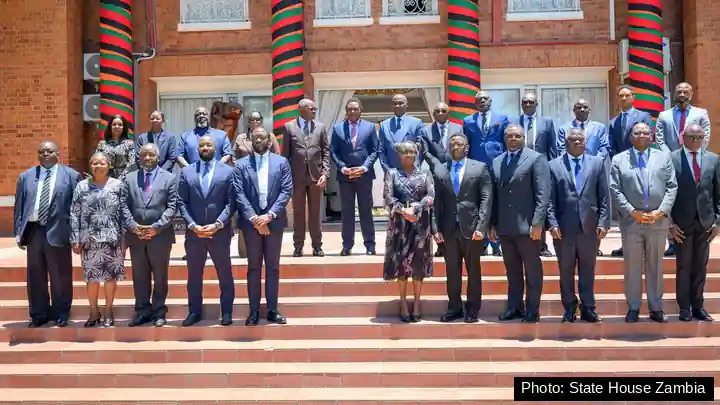
Featured photo: State House Zambia.
Related coverage
- Seizing the Critical Minerals Moment Is Africa’s Path to Industrialisation
- Lobito Corridor Talks Open in Lusaka With a US$28 Billion Investment Pipeline on the Table
- Zambia Secures US$6.17 Million Japanese Grant to Support Railway Revival
- Musokotwane Presses KoBold to Fast-Track Mingomba Copper Mine
- Libala to the Value Chain: How Ordinary Zambians Can Plug Into the Grow Zambia Agenda
WARNING! All rights reserved. This material and all other digital content on this website may not be reproduced, published, broadcast, rewritten, or redistributed, in whole or in part, without the prior express permission of The Zambian Economist. Where permission is granted, the content must be clearly credited to “The Zambian Economist,” with “www.zambianeconomist.com” prominently displayed.
WhatsApp: +260775574228 | Email: info@zambianeconomist.com
© 2026 The Zambian Economist.