
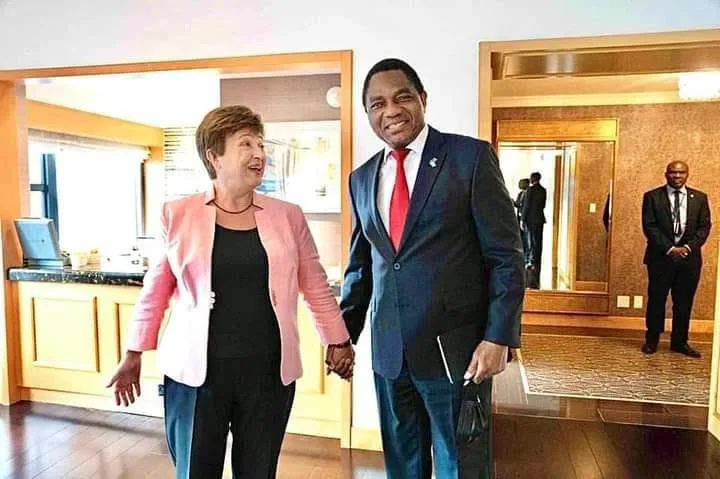
IMF Managing Director Kristalina Georgieva has congratulated President Hakainde Hichilema on his re-election and pledged continued support as Zambia prepares for the next phase of its economic relationship with the Fund.
Key takeaways
- IMF Managing Director Kristalina Georgieva has congratulated President Hakainde Hichilema on his re-election.
- Georgieva said the Fund remains unequivocally committed to supporting Zambia’s development agenda.
- Zambia completed its 38-month Extended Credit Facility arrangement in January 2026 after receiving about US$1.7 billion.
- Talks on a successor IMF-supported arrangement were expected to resume after the August election.
The International Monetary Fund has congratulated President Hakainde Hichilema on his re-election and said it wants to work closely with his administration on Zambia’s development priorities.
In a message to the President, IMF Managing Director Kristalina Georgieva assured him of the Fund’s “unequivocal commitment to supporting Zambia’s ambitious developmental agenda”.
Georgieva said the IMF looked forward to strengthening its engagement with the new administration and advancing the shared objective of building a prosperous Zambia.
Why the IMF message carries economic weight
The congratulatory message comes at a turning point in Zambia’s relationship with the Fund. In January, the IMF Executive Board completed the sixth and final review of the country’s 38-month Extended Credit Facility arrangement. The programme, approved in August 2022 and later expanded, delivered total financing of about US$1.7 billion.
The IMF said when the final review was completed that policy attention in 2026 should remain on fiscal discipline and policy credibility. It also called for continued work on debt sustainability, private-sector participation and economic diversification.
By May, Zambia and IMF staff had advanced discussions on a successor arrangement. Those negotiations were expected to resume with the incoming government after the August election, according to an IMF statement following a staff visit to Lusaka.
What Zambia and the IMF may discuss next
A congratulatory letter does not set the terms of a new programme. Formal negotiations will determine the policies, financing and review conditions attached to any successor arrangement.
When IMF staff visited Zambia in May, they said gross international reserves had reached US$6.4 billion, equal to 4.4 months of prospective imports, while inflation had fallen to 6.8% in April. The same mission warned of growing fiscal pressure in 2026 and projected a lower primary surplus if corrective measures were not taken.
The Government had expressed interest in a new Fund-supported programme built around sound macroeconomic policy and fiscal consolidation, while protecting social and other priority spending. The balance between those objectives will matter in the next round of talks.
What businesses and households should watch
For businesses, the immediate questions concern policy certainty, the exchange rate, access to foreign currency and the Government’s approach to spending and arrears. A successor arrangement could provide an external anchor for fiscal and monetary policy, but the details will determine how companies experience it.
For households, an IMF commitment does not by itself change food prices, electricity supply or wages. The practical effect will depend on the policies agreed with the Fund, the protection given to social spending and whether economic stability produces stronger employment and household incomes.
The next signal to watch is the formal resumption of Zambia-IMF negotiations and the Government’s statement of priorities for a successor programme.
Related coverage
- Hichilema’s Second Term: What It Means for Zambia’s Economy, Markets and Diplomacy
- Zambia’s Turnaround Won the Election. Now It Has to Deliver.
- President Hichilema Hosts Chinese Ambassador Han Jing for Courtesy Call in Lusaka
- More Economic Diplomacy coverage
WARNING! All rights reserved. This material and all other digital content on this website may not be reproduced, published, broadcast, rewritten, or redistributed, in whole or in part, without the prior express permission of The Zambian Economist. Where permission is granted, the content must be clearly credited to “The Zambian Economist,” with “www.zambianeconomist.com” prominently displayed.
WhatsApp: +260775574228 | Email: info@zambianeconomist.com
© 2026 The Zambian Economist.